Dassault Aviation reported total sales of €7.42 billion for the full year 2025, marking a 19.1% increase over the €6.23 billion recorded in 2024. The company’s net profit reached €1.06 billion, remaining nearly level with the previous year’s €1.05 billion. While total revenue grew significantly, the actual percentage of profit kept from each Euro earned dropped slightly from 17% to 14.3% due to rising costs and shifts in the types of aircraft delivered.
The company’s total backlog grew to €46.60 billion, up from €43.22 billion the previous year. This growth was fueled by €10.94 billion in new orders during 2025. A standout deal was the selection of the Rafale Marine fighter by the Indian Navy for 26 aircraft, a major win that ensures the production line for the carrier-based version of the jet will remain active for years. These wins reflect a global trend where nations are aggressively updating their military hardware in response to rising international tensions.
Looking ahead to 2026, the company expects sales to climb even further to €8.5 billion. This target is based on the planned delivery of 28 Rafale fighter jets and 40 Falcon business jets. While the massive pile of existing orders makes future revenue predictable, the company faces risks related to the global supply chain. Company leadership characterized the operating environment as demanding, citing geopolitical uncertainty, U.S. tariff-related commercial disruptions in the first half of 2025, an evolving French military programming law, and domestic tax pressure as factors creating friction for both military and civil programs. The main challenge for 2026 is whether the company can ramp up production and build each aircraft faster in order to hit its higher delivery targets.
INDUSTRY SEGMENTS
Falcon (Business Jets)
The Falcon division delivered 37 aircraft in 2025. While an improvement over the 31 jets delivered the year before, it fell short of the company’s original goal of 40. New orders for the year totaled 31 jets, up from 26 in 2024. Demand for these large-cabin, long-range jets remained steady, though some customers were hesitant early in the year due to uncertainty over international trade policies, tariffs and potential new taxes.
Profit levels for the Falcon business were affected by the production ramp-up of newer models and the associated learning-curve effects on more advanced models, which are more expensive and complex to initially assemble. The segment’s profitability remains sensitive to delivery timing and the specific mix of aircraft models, as larger and more advanced jets typically generate a higher percentage of profit per sale.
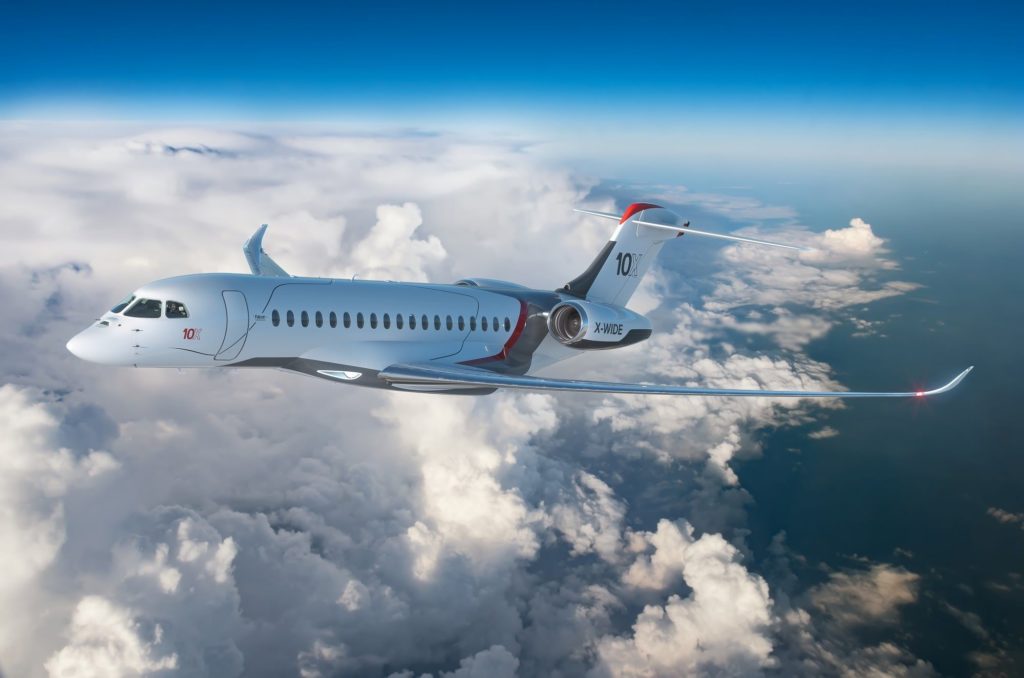
Looking ahead, the upcoming launch of the Falcon 10X will test whether Dassault can successfully take market share from established rivals in the ultra-long-range private jet sector. Meanwhile, the launch of a new Falcon service and finishing center in Melbourne, Florida, serves as a key move to earn more from long-term maintenance and repair work while improving customer service scores. This focus on better supporting private jet owners has been labeled a top priority for the company heading into 2026.
Defense (Military Aircraft)
The military division saw a boost in activity, delivering 26 Rafale fighters in 2025, which was one more than originally planned. More than half of these jets were sent to international customers, while the remainder went to the French Air and Space Force. The Rafale remains the company’s most important product, with 220 jets currently on order. This global demand is driven by countries looking to modernize their air forces with proven technology that is independent of U.S. or Russian supply chains.
Profitability in the defense sector stayed healthy due to the high volume of deliveries, but the company had to manage the rising costs of raw materials and energy. Because many defense deals are “fixed-price” contracts signed years in advance, the company must absorb any unexpected increases in manufacturing costs. However, lower internal spending on research and development this year helped protect the bottom line as the current version of the Rafale jet has reached a mature, efficient stage of production.
A shift is underway as the Rafale fighter jet becomes a global export powerhouse; international customers accounted for 58% of all deliveries this year. This successful expansion into markets across Europe, South Asia, and the Middle East ensures the company’s factories will remain busy for the foreseeable future. Furthermore, if a pending deal for 114 jets with India is finalized, it would secure production well into the next decade and significantly lower the average cost of building each aircraft.

A military history enthusiast, Richard began his career at Forecast International as editor of the World Weapons Weekly newsletter. As the Internet became central to defense research, he helped design the company’s Forecast Intelligence Center and now coordinates the FI Market Recap newsletters for clients. He also manages two blogs: Defense & Security Monitor, which covers defense systems and international security issues, and Flight Plan, focused on commercial aviation and space systems.
For more than 30 years, Richard has authored Defense & Aerospace Companies, Volume I (North America) and Volume II (International), providing detailed data on major aerospace and defense contractors. He also edits the International Contractors service, a database tracking all companies involved in programs covered by the FI library. Richard currently serves as Manager of the Information Services Group (ISG), which develops outbound content for both Forecast International and Military Periscope.