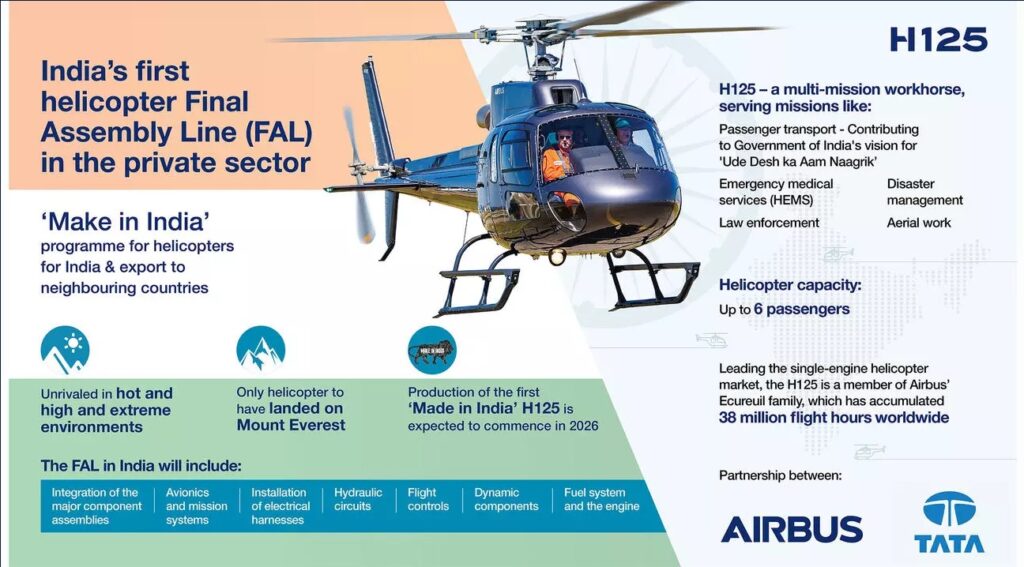
Airbus Helicopters is partnering with India’s Tata Group to establish a Final Assembly Line (FAL) for H125 helicopters in the country. The Indian FAL will produce the light single engine helicopter for both the Indian market and export customers in nearby countries.
Under this partnership, Tata Advanced Systems Limited (TASL), a subsidiary of Tata Group, will set up the facility along with Airbus Helicopters. Airbus says the new FAL will be the first private sector helicopter manufacturing facility in India.
Airbus made the announcement during the two-day visit of French President Emmanuel Macron to India. The manufacturer says the FAL will contribute to the Indian government’s ongoing “Make in India” program to boost manufacturing in the country.
At the FAL, Tata will handle major component assemblies, avionics and mission systems, installation of electrical harnesses, hydraulic circuits, flight controls, dynamic components, fuel system and the engine. It will also do testing, qualification, and delivery of the H125 to customers in India and the surrounding region.
Airbus expects it will take 24 months to set up the FAL. Deliveries will begin in 2026. The location of the FAL has yet to be determined, but it will be jointly decided by Airbus and the Tata Group.
The new H125 production facility will be the second final assembly line Airbus is building in India. The manufacturer is also building a C295 military transport manufacturing facility in Gujarat to fill an Indian order for the aircraft.

Douglas Royce covers the aviation gas turbine and military markets at Forecast International, a market research firm that forecasts annual production across a wide range of aerospace and defense systems.