Widebody Production Gains Drastically Reduce Lead Times /// Narrowbody Lead Times Rise

ATR Final Assemble Line – Image – ATR
For the purposes of this article, Forecast International considers an aircraft to be “produced” once it completes its first test flight, and “delivered” when it is contractually handed over to the customer.
Production by Market Segment
Total commercial aircraft production in April 2026 rose to 133 aircraft, a slight increase from the 128 units produced in March, maintaining the momentum established at the end of the first quarter. As expected, Narrowbody production made up the vast majority of activity with 103 aircraft, a four aircraft decrease from the 107 produced last month. Most notably, widebody output saw a healthy increase to 24 aircraft, up from 16 in March. This growth in the widebody segment was driven by a significant acceleration in the A350 and 787 programs, both of which operated at or above their current production target rates during the month. Regional jet production held steady at three aircraft, while turboprop production also recorded three units for the month. On a year-to-month (YTM) basis, total commercial aircraft production has reached 462 aircraft through the first four months of 2026. Narrowbodies continue to lead the market with 371 aircraft, followed by 75 widebodies. Regional jet and turboprop production remain modest contributors to the year’s totals, standing at 10 and 6 aircraft, respectively.
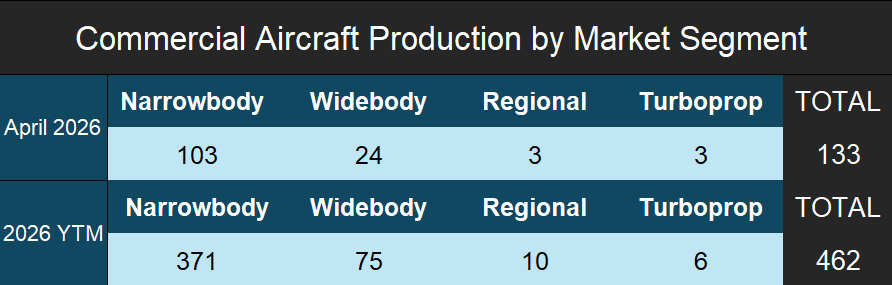
- Production data represents the actual number of aircraft produced in April 2026. Forecast International considers an aircraft produced upon its first flight. This may differ from an OEM’s definition of produced.
Average Production-to-Delivery Lead Times
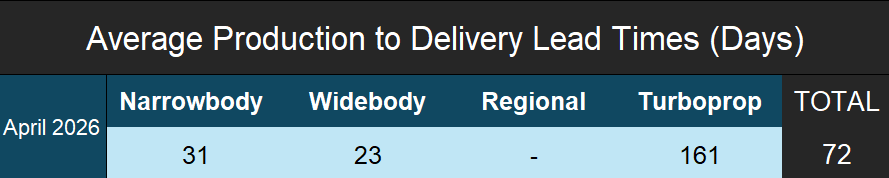
Average production-to-delivery lead times saw a notable shift in April. While the widebody segment saw improvements, narrowbody lead times increased to an average of 31 days from production to delivery, a one-week rise over the 24 days recorded in March. This increase was driven by production-to-delivery bottlenecks for the A320neo family, which are resulting in a buildup of undelivered inventory and hurting Airbus’s ability to maintain a healthy delivery rate.
In stark contrast, widebody lead times reached a very healthy average of 23 days, which is a sharp decrease from previous months. This improvement is attributed to much stronger widebody production performance from both Boeing and Airbus after the programs had struggled earlier in the year. Furthermore, the bottleneck caused by stored inventory has largely dissipated as the remaining 787 inventory is now nearly cleared. This is allowing for a smoother, more direct flow from the factory line to the customer. Turboprop lead times stood at 161 days, reflecting the longer-cycle delivery schedules typical for that segment. No regional jet lead-time data was recorded for April due to a lack of paired events. Across all segments, the average lead time for April was 72 days.
Projected Deliveries
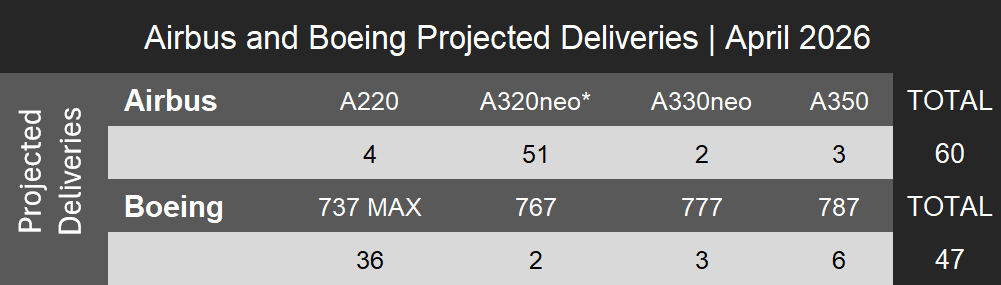
Forecast International estimates that Airbus and Boeing combined delivered approximately 107 aircraft in April 2026, which is a moderate increase from the 99 estimated in March. Airbus is projected to have delivered 60 aircraft, dominated by 51 A320neo-family narrowbodies. While the four A220 deliveries represent a dip from the previous month, the A320neo family showed a significant recovery toward its monthly production targets. Widebody deliveries for Airbus remained lean, consisting of two A330neos and three A350s. Boeing delivered an estimated 47 aircraft during the month, representing a slight improvement over the 45 delivered in March. This total was supported by 36 737 MAX aircraft, while widebody activity remained focused on finishing the inventory clearing process, including six 787s, three 777s, and two 767s.
Notes:
- Delivery data is the expected number that Boeing and Airbus will report in their April 2026 Orders and Deliveries summary and is based on Forecast International’s internal research. Numbers are not official and are not provided by Airbus or Boeing.
- A320neo numbers include all variants for the family; A319neo, A320neo and A321neo
To get a more detailed, month‑by‑month breakdown of commercial aircraft OEM activity, including production, orders, and delivery execution risk, visit https://figlobalintelligence.com/commercial-aircraft-oem-intelligence-brief/

With diverse experience in the commercial aviation industry, Grant joins Forecast International as the Lead Analyst for Commercial Aerospace. He began his career at the Boeing Company, where he worked as a geospatial analyst, designing and building aeronautical navigation charts for Department of Defense flight operations.
Grant then joined a boutique global aviation consulting firm that focused on the aviation finance and leasing industry. In this role he conducted valuations and market analysis of commercial aircraft and engines for banks, private equity firms, lessors and airlines for the purposes of trading, collateralizing and securitizing commercial aviation assets.
Grant has a deep passion for the aviation industry and is also a pilot. He holds his Commercial Pilots License and Instrument Rating in addition to being a FAA Certified Flight Instructor.