Boeing Leads Airbus in Year to Date Deliveries // Massive Order Surge Bolsters Airbus Backlog // Boeing Maintains Steady Widebody Momentum
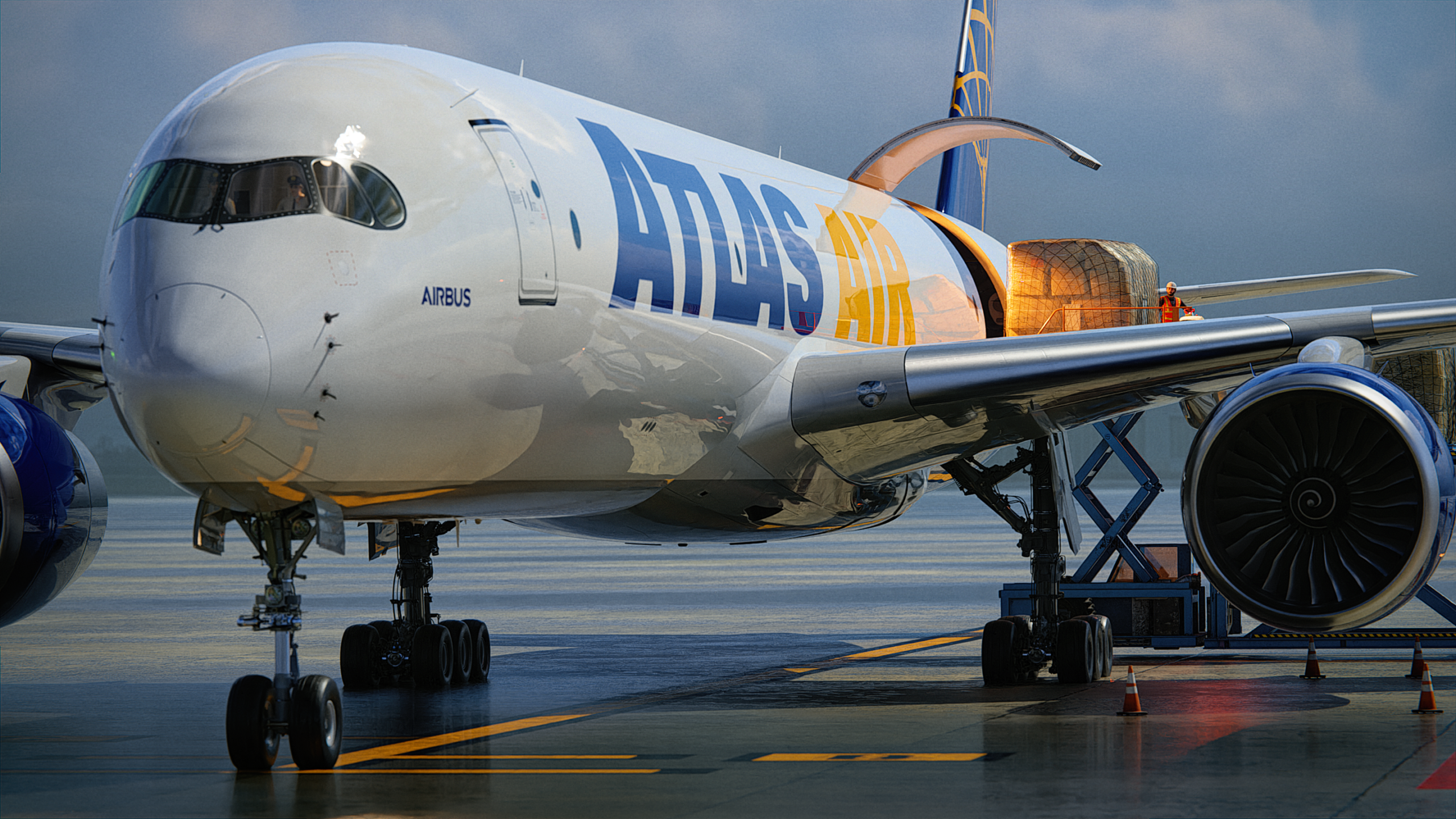
Atlas Air A350F. Image – Airbus
March 2026 Summary
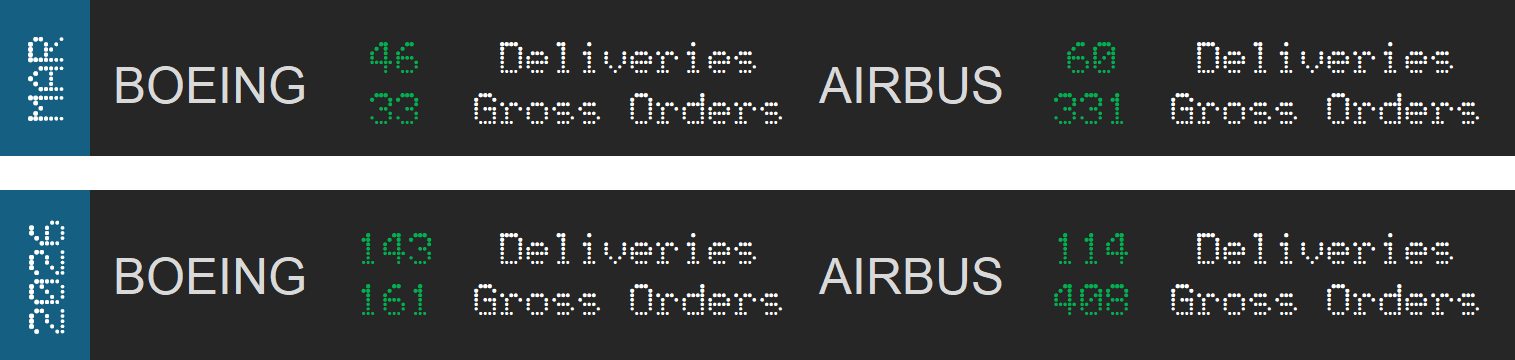
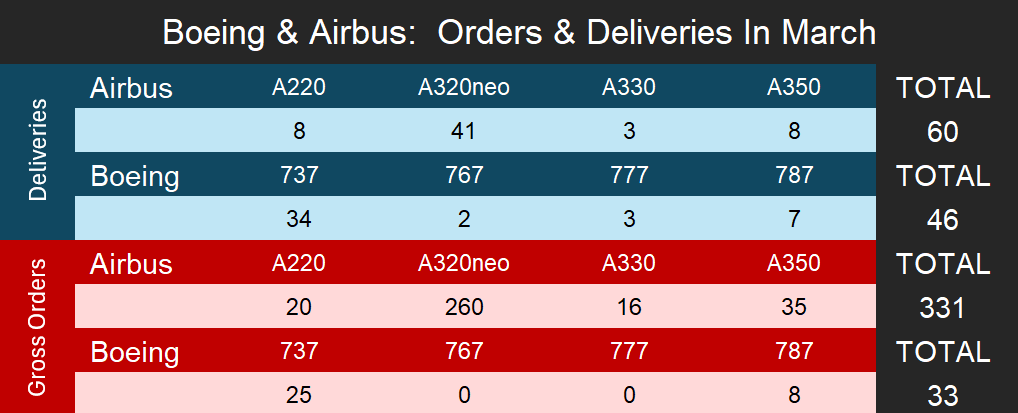
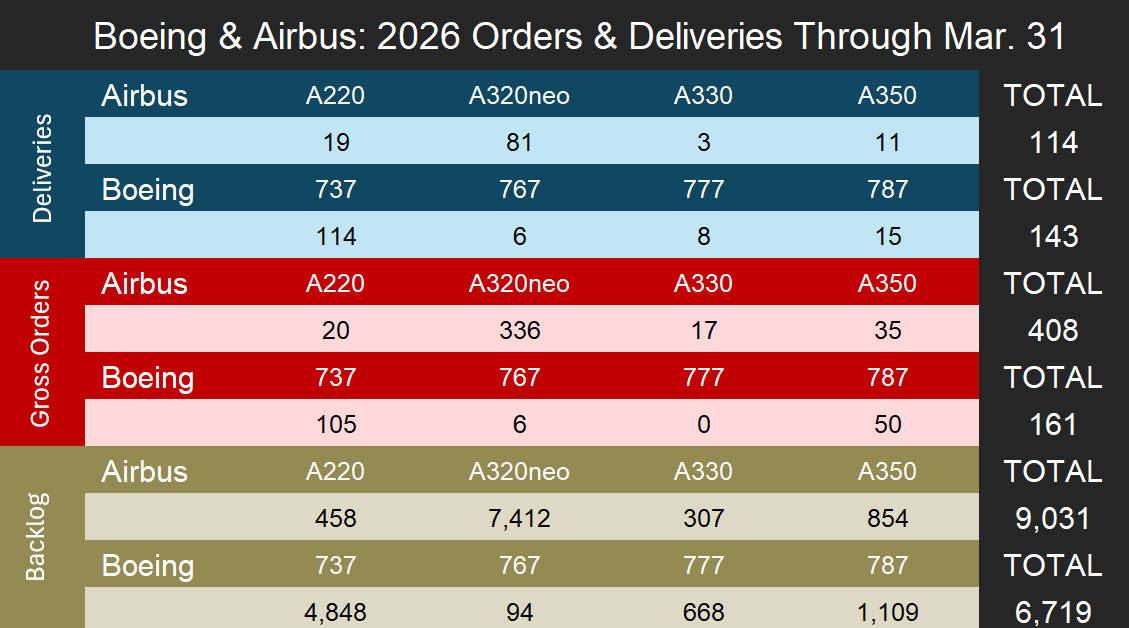
In March 2026, Airbus reclaimed the delivery lead, handing over 60 commercial aircraft, a significant recovery from its 35 deliveries in February. Despite this monthly surge, Boeing maintained a lead for the total first quarter of 2026, delivering 46 aircraft in March to bring its Q1 total to 143 aircraft, compared to Airbus’s 114 aircraft. Airbus’s performance was bolstered by a pick-up in narrowbody output, while Boeing’s volume was slightly constrained by a decrease in MAX deliveries to 33 aircraft in March. The month was also most notable for a massive divergence in order activity. Airbus booked a staggering 331 gross orders, driven by massive fleet renewal commitments from major lessors and Chinese carriers. Boeing recorded a more conservative but steady 33 gross orders, maintaining a balanced intake across its 737 and 787 programs.
Notes:
- A320neo numbers include all variants for the family; A319neo, A320neo and A321neo.
Boeing Deliveries
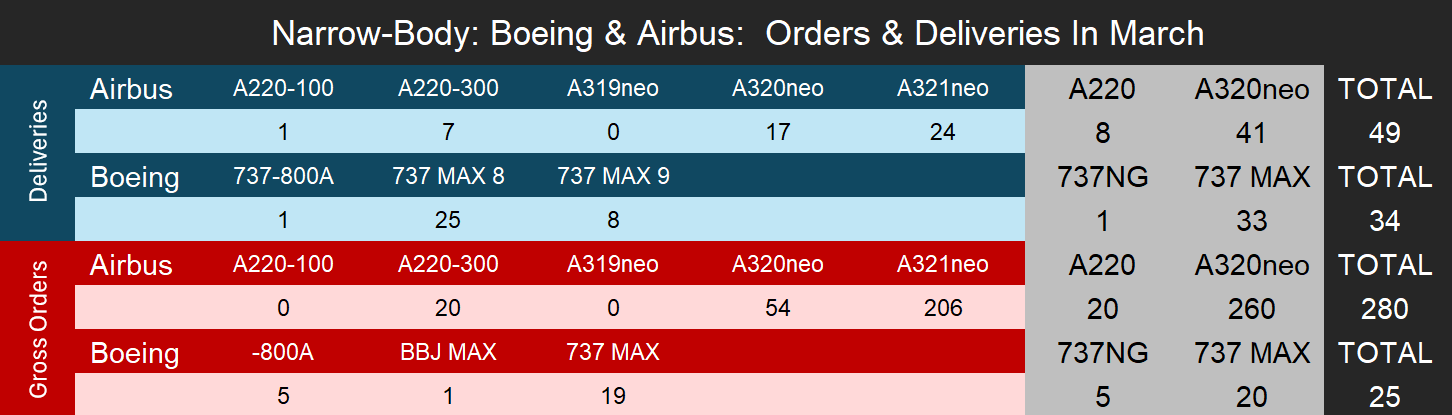
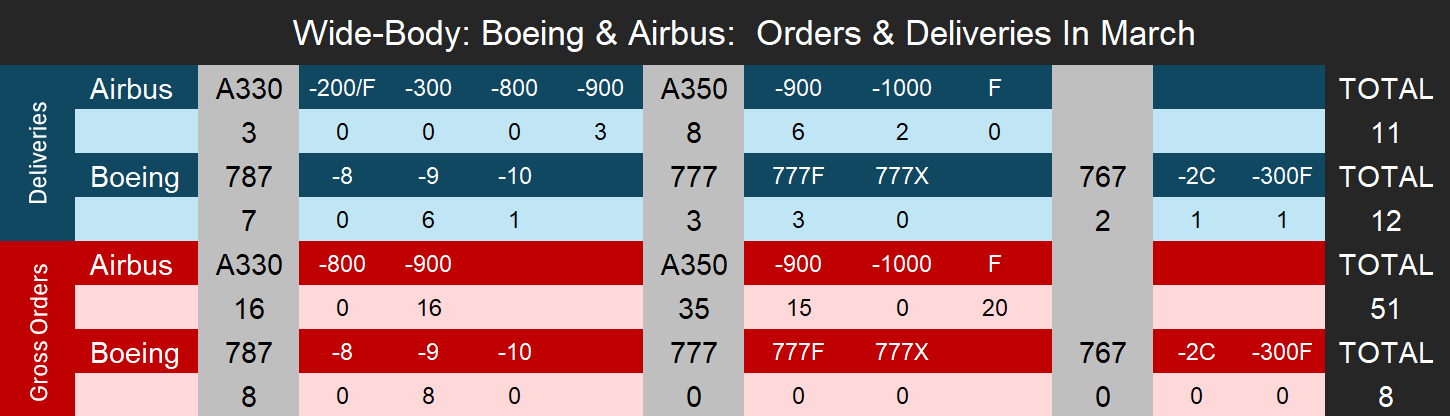
Boeing delivered 46 aircraft in March, consisting of 34 narrowbodies and 12 widebodies. The narrowbody total included 33 737 MAX jets and one 737NG. Delivery volume for the month was slightly lower than February’s 51 units, as Boeing conducted inspections and rework on approximately 25 737 MAX aircraft following the discovery of a wiring defect. On the widebody side, Boeing delivered seven 787 Dreamliners, three 777s, and two 767s. Despite the minor monthly dip, Boeing’s ability to deliver 143 aircraft in the first quarter of 2026 keeps it ahead of its prior-year Q1 pace and ahead of Airbus for the year-to-date period.
Airbus Deliveries
Airbus delivered 60 aircraft in March, a sharp increase from the 35 units delivered in February. The total included 49 narrowbody aircraft, comprising 41 A320neo family jets and eight A220s. Widebody activity also improved significantly, with 11 aircraft handed over, including eight A350s and three A330neos. While the 60 deliveries in March represent a strong monthly performance, Airbus’s Q1 total of 114 deliveries continues to reflect the impact of supply chain bottlenecks, particularly shortages of Pratt & Whitney engines, which have hampered the company’s efforts to reach its aggressive “Rate 75” production targets for the A320neo program.
Boeing Orders
Boeing recorded 33 gross orders in March. The intake was relatively balanced between single-aisle and twin-aisle aircraft, with 25 orders for the 737 program (including 20 MAX aircraft and 5 NG variants) and eight orders for the 787 Dreamliner. This consistent order flow brings Boeing’s year-to-date gross order total to 161 aircraft.
- For consistency, this article does not include Boeing’s ASC 606 accounting adjustments and considers net orders as gross orders minus cancellations.
Airbus Orders
Airbus recorded 331 gross orders in March, with the A320neo family accounting for the overwhelming majority of the activity. Significant milestones included a 100-aircraft order from AerCap and a 101-aircraft commitment from China Eastern Airlines. Beyond narrowbodies, Airbus secured 20 orders for the A350F freighter from Atlas Air Worldwide and 15 orders for the A350-900 passenger variant. This surge in order activity during the month of March highlights the massive demand for the A321neo variant and the A350 freighter as airlines and lessors seek secure delivery slots that now extend well into the 2030s.
Backlog
- Airbus backlog numbers do not include A320ceo ghost orders.
- Boeing backlog numbers do not include 737-800 and 777-300ER ghost orders.
- A320neo numbers include all variants for the family; A319neo, A320neo and A321neo
As of March 31st, 2026, Airbus reported a commercial aircraft backlog of 9,031 aircraft. Based on the company’s 2026 delivery target of 870 aircraft, this represents approximately 10.4 years of production coverage. The backlog is dominated by 7,870 narrowbody aircraft, of which 70.4% is for the A321neo. The widebody backlog also remains healthy with over 1,161 aircraft, including the growing A350 and A330neo order books.
Boeing’s commercial backlog stood at approximately 6,719 aircraft at the end of March. Using Forecast International’s production estimates, Boeing’s backlog equates to roughly 10.1 years of production coverage. The 737 MAX remains the cornerstone of Boeing’s order book with 4,830 outstanding orders, while Boeing continues to hold a strong position in the widebody segment with over 1,800 aircraft on order across the 787, 777, and 767 programs.
To get a more detailed, month‑by‑month breakdown of commercial aircraft OEM activity, including production, orders, and delivery execution risk, visit https://figlobalintelligence.com/commercial-aircraft-oem-intelligence-brief/

With diverse experience in the commercial aviation industry, Grant joins Forecast International as the Lead Analyst for Commercial Aerospace. He began his career at the Boeing Company, where he worked as a geospatial analyst, designing and building aeronautical navigation charts for Department of Defense flight operations.
Grant then joined a boutique global aviation consulting firm that focused on the aviation finance and leasing industry. In this role he conducted valuations and market analysis of commercial aircraft and engines for banks, private equity firms, lessors and airlines for the purposes of trading, collateralizing and securitizing commercial aviation assets.
Grant has a deep passion for the aviation industry and is also a pilot. He holds his Commercial Pilots License and Instrument Rating in addition to being a FAA Certified Flight Instructor.