Deliveries Rebound Across Both OEMs Following August Slowdown // Airbus Orders Fall Sharply While Boeing Experiences Strong Surge // 737 MAX Deliveries Show Strong Performance In Line with Target Production Rate
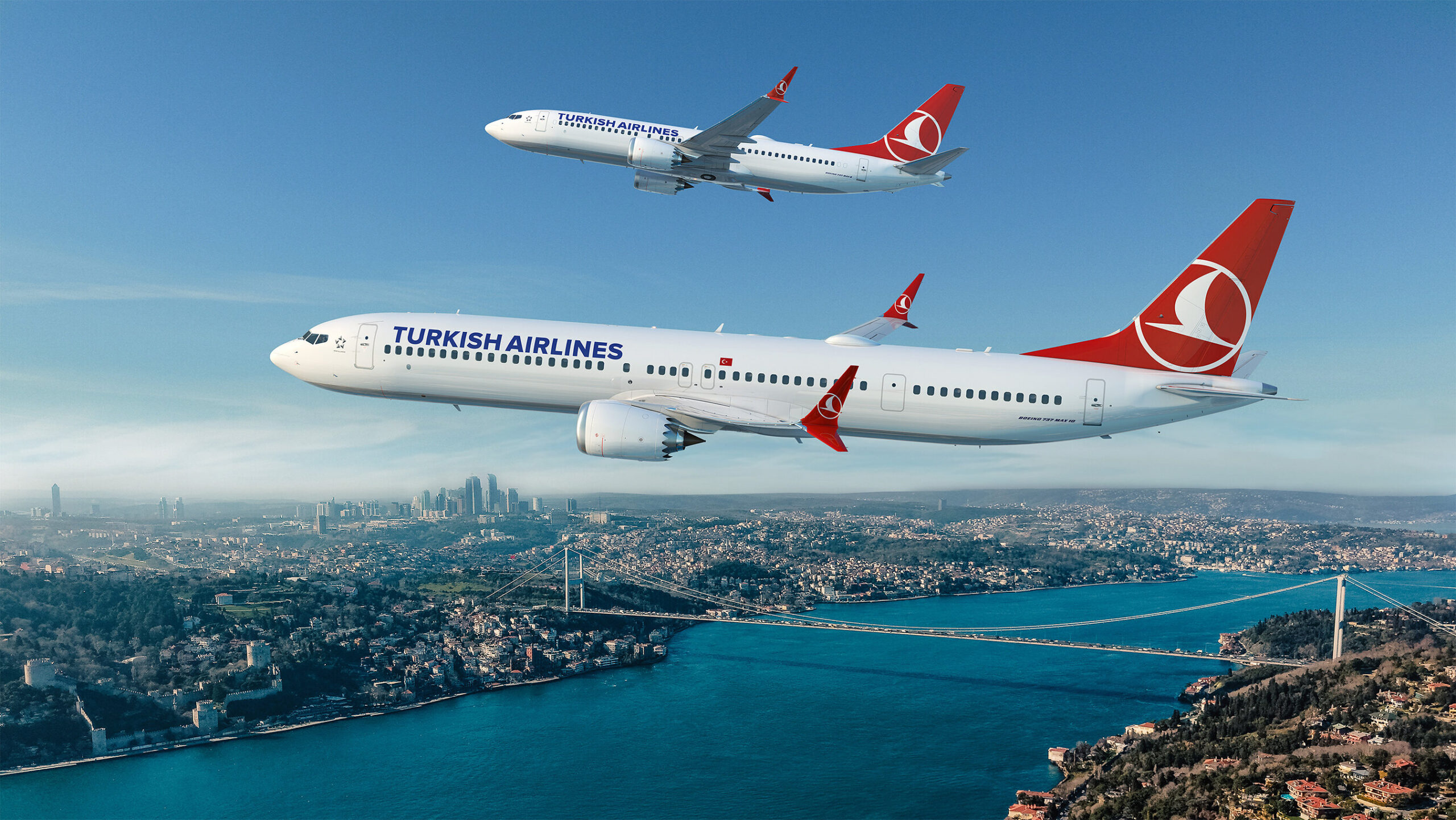
Turkish Airlines 737 MAXs. Image – Boeing
August 2026 Summary
The data and commentary presented in this article offer a high-level overview of Airbus and Boeing based strictly on publicly disclosed information. Our comprehensive Commercial Aircraft OEM Intelligence Brief incorporates broader performance indicators not disclosed by OEMs to evaluate the true health and execution of commercial aircraft programs. For in-depth OEM analysis and program-level insights, explore the full Commercial Aircraft OEM Intelligence Brief.
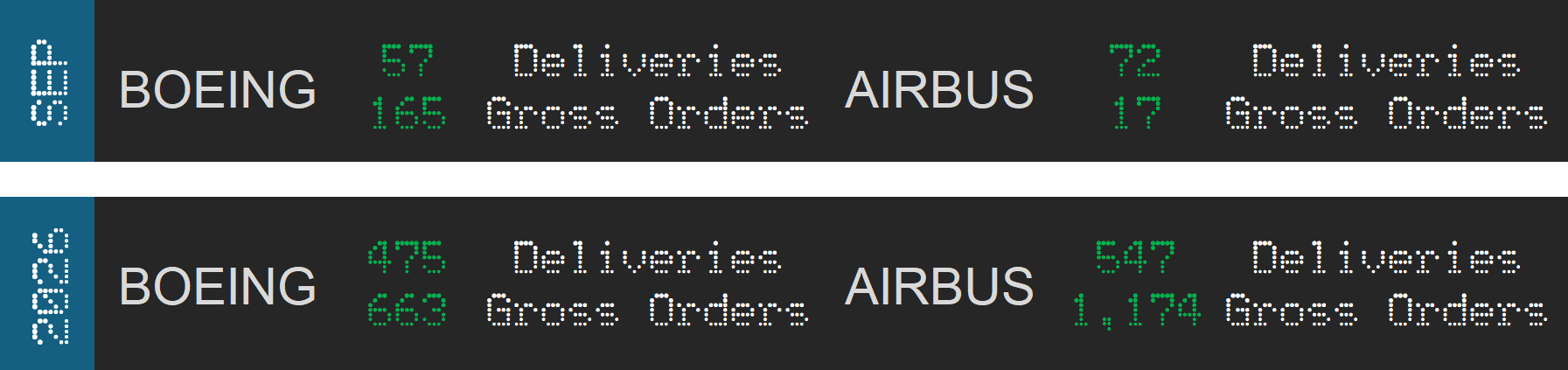
Commercial aircraft delivery and order activity shifted in September 2026, characterized by higher delivery volumes at Airbus and an influx of new order bookings for Boeing. Airbus delivered 72 commercial jets during the month, driven predominantly by its narrowbody lineup through 59 A320neo family aircraft and eight A220s, though the widebody segment lagged with only 5 deliveries. This brought Airbus’s total 2026 deliveries to 547 aircraft out of its full-year objective of roughly 870 units. Meanwhile, Boeing completed 57 deliveries in September, including 43 737 MAXs and 14 widebodies, bringing its year-to-date total to 475 aircraft. While Boeing increased its monthly delivery output compared to August, Airbus expanded its delivery advantage over Boeing to 72 aircraft through the first nine months of the year.
In terms of orders, the two manufacturers experienced opposite dynamics in their monthly order books following August’s quieter market conditions. Airbus recorded a modest month with just 17 gross orders, all focused on its A320neo family. On the other hand, Boeing logged a major rebound with 165 gross orders, heavily driven by strong demand for the 737 MAX alongside 23 787 and ten 777 orders. Despite Boeing capturing over ninety percent of September’s gross orders, Airbus maintains its overall sales lead for the year with 1,174 gross orders compared to Boeing’s 663 aircraft through September 30th. Looking at total order books, Airbus holds a backlog of 9,304 aircraft compared to Boeing’s 6,856 aircraft.
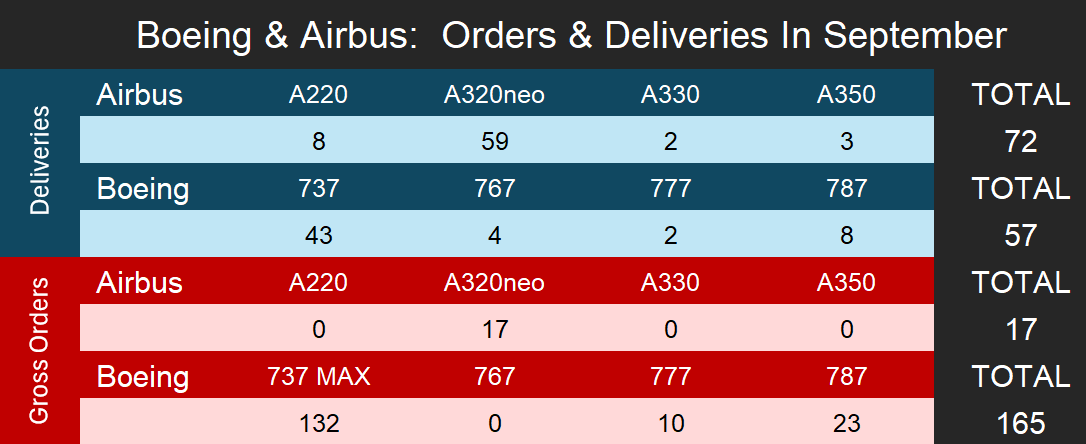
- A320neo numbers include all variants for the family; A319neo, A320neo and A321neo.
Boeing Deliveries
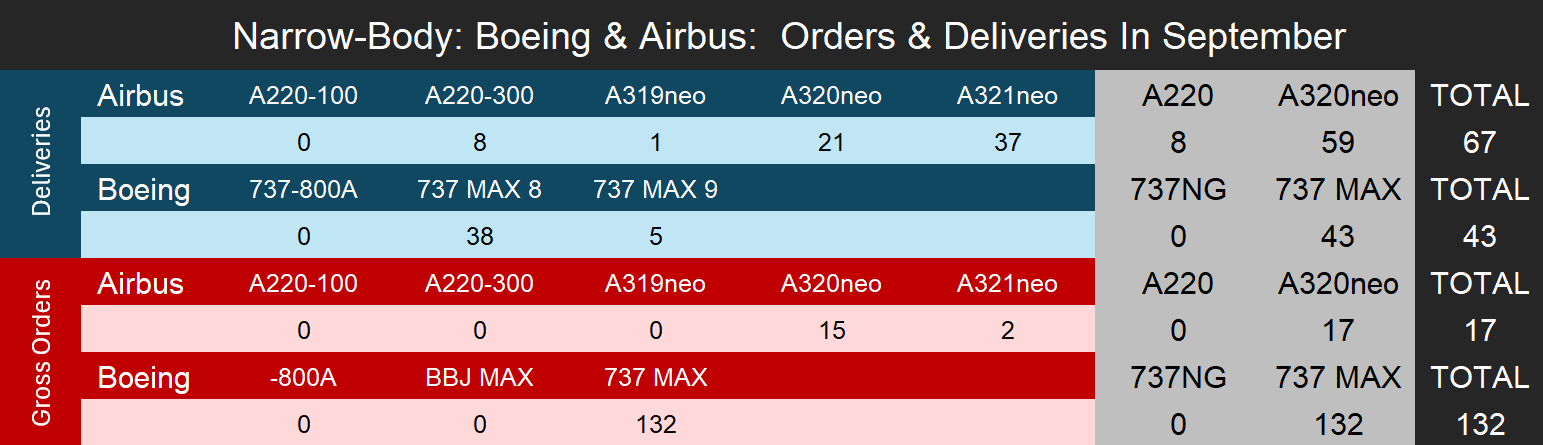
Boeing delivery activity increased during September, as total commercial aircraft handed over reached 57 units compared to 51 in the prior month. The 737 MAX represented the primary portion of this number, accounting for 43 total 737 family deliveries that comprised 38 737 MAX 8 models and 5 737 MAX 9 variants. Reaching 43 MAX deliveries in a single month is positive sign for the aircraft and indicates operational stabilization in line with the program’s target production rate. Following the MAX 7 certification in early August, Boeing remains positioned to clear parked inventory built for Southwest Airlines, though initial deliveries are not expected to begin until 2027.
As for the widebody segment, Boeing delivered 14 twin-aisle aircraft in September, up from nine units in August. Deliveries in this category included eight 787 Dreamliners (seven -9s and one -10), four 767s (3 -2C models and 1 -300F), and two 777 Freighters. The increase in 787 deliveries to eight aircraft reflects operational improvement for the program, aligning with its target rate of eight aircraft per month as production stabilizes and stored inventory continues to be drawn down.
Airbus Deliveries
Airbus commercial aircraft deliveries increased in September, with the manufacturer delivering 72 commercial jets compared to 57 in August. Single-aisle aircraft represented the main share of this output at 67 deliveries, which was heavily driven by the A320neo family with 59 aircraft (comprising 37 A321neos, 21 A320neos, and one A319neo) alongside eight A220-300s. While single-aisle models continue to account for the vast majority of deliveries, the A220 returned to its established baseline pace of 8 deliveries following August’s spike. In sharp contrast, the widebody segment continues to experience severe production and delivery bottlenecks, adding only five aircraft to September’s total (consisting of three A350-900 variants and two A330-900s). Widebody programs remain significantly behind the operational pace required to meet our current full-year forecasts, creating ongoing risks to Airbus’s annual delivery goal. Through the first nine months of 2026, Airbus has accumulated 547 total deliveries, maintaining its overall lead over Boeing. However, with widebody output continuing to underperform severely, hitting its full-year target of approximately 870 commercial aircraft depends heavily on the A320neo family driving an aggressive fourth-quarter delivery acceleration.
Boeing Orders
Boeing order intake experienced a sharp increase in September, securing 165 new gross commitments following July and August’s subdued performance. Demand was overwhelmingly driven by single-aisle orders, where the 737 MAX platform captured 132 gross bookings. Widebody activity also contributed meaningfully to the monthly total through 33 gross orders, comprising 23 787 Dreamliners (22 -10s and one -9) alongside ten 777 aircraft (eight 777X and two 777 Freighters). These additions pushed Boeing’s total 2026 gross orders to 663 aircraft through September 30th. While September’s strong order intake narrowed the gap, the manufacturer remains well behind Airbus, which continues to hold a substantial sales lead for 2026 with 1,174 gross orders.
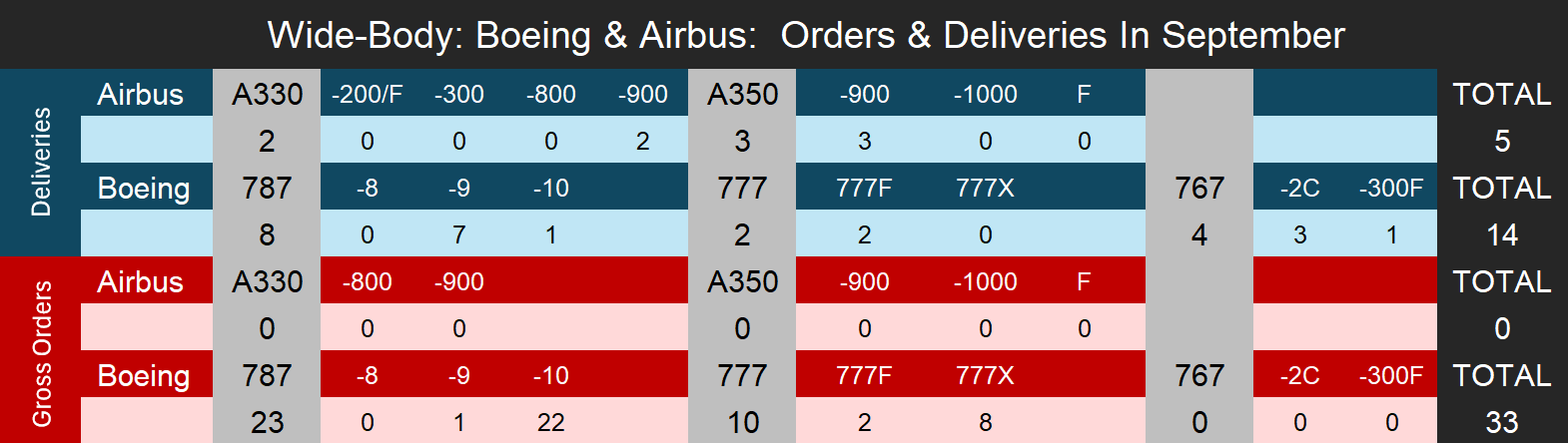
- For consistency, this article does not include Boeing’s ASC 606 accounting adjustments and considers net orders as gross orders minus cancellations.
Airbus Orders
Unlike Boeing, Airbus order intake experienced a sharp slowdown in September, securing only 17 new gross commitments following a high level of sales during the July airshow season and a moderate August. Single-aisle aircraft accounted for the entirety of the monthly intake, with all 17 gross orders concentrated in the A320neo family (comprising 15 A320neos and two A321neos). Widebody platforms recorded no new order activity for the month, as both the A330 and A350 families logged zero gross additions. These new orders brought Airbus’s 2026 gross order total to 1,174 aircraft through September 30th. Despite the light monthly showing, Airbus continues to command a substantial lead over Boeing, maintaining a margin of 511 gross orders for 2026.
Backlog
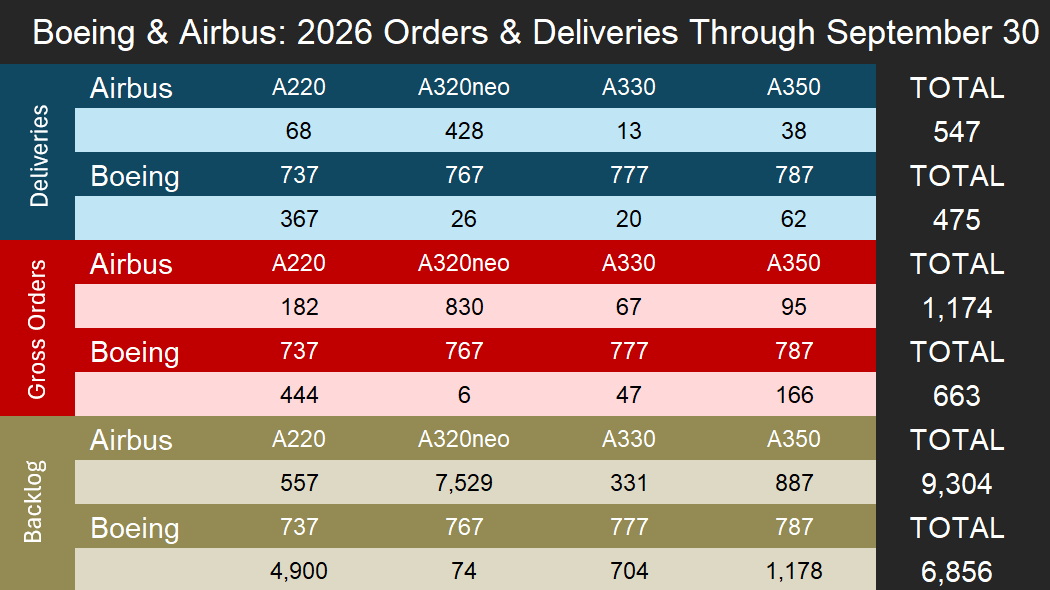
- Airbus backlog numbers do not include A320ceo ghost orders.
- Boeing backlog numbers do not include 777-300ER ghost orders.
- A320neo numbers include all variants for the family; A319neo, A320neo and A321neo
Airbus’s total order backlog reached 9,304 aircraft, representing a net decrease from August as higher monthly deliveries outpaced the soft orders for the month. Single-aisle aircraft continue to dominate Airbus’s remaining commitments, led by 7,529 unfilled orders for the A320neo family and 557 commitments for the A220. Widebody platforms remain a significantly smaller portion of the portfolio, accounting for 1,218 aircraft, consisting of 887 orders for the A350 and 331 for the A330 family. Based on Airbus’s full-year target of approximately 870 deliveries, its total order backlog provides roughly 10.7 years of production visibility. On the Boeing side, the total commercial backlog expanded to 6,856 aircraft at the end of September, reflecting a net increase as strong order intake outpaced monthly deliveries. Narrowbody aircraft represent the majority of Boeing’s remaining commitments, supported by 4,900 orders for the 737 family. The widebody segment comprises 1,956 aircraft, including 1,178 orders for the 787 Dreamliner, 704 for the 777 series, and 74 for the 767 program. Based on our projected delivery rates for 2026, Boeing’s current order book represents approximately 10.2 years of manufacturing output.

With diverse experience in the commercial aviation industry, Grant joins Forecast International as the Lead Analyst for Commercial Aerospace. He began his career at the Boeing Company, where he worked as a geospatial analyst, designing and building aeronautical navigation charts for Department of Defense flight operations.
Grant then joined a boutique global aviation consulting firm that focused on the aviation finance and leasing industry. In this role he conducted valuations and market analysis of commercial aircraft and engines for banks, private equity firms, lessors and airlines for the purposes of trading, collateralizing and securitizing commercial aviation assets.
Grant has a deep passion for the aviation industry and is also a pilot. He holds his Commercial Pilots License and Instrument Rating in addition to being a FAA Certified Flight Instructor.