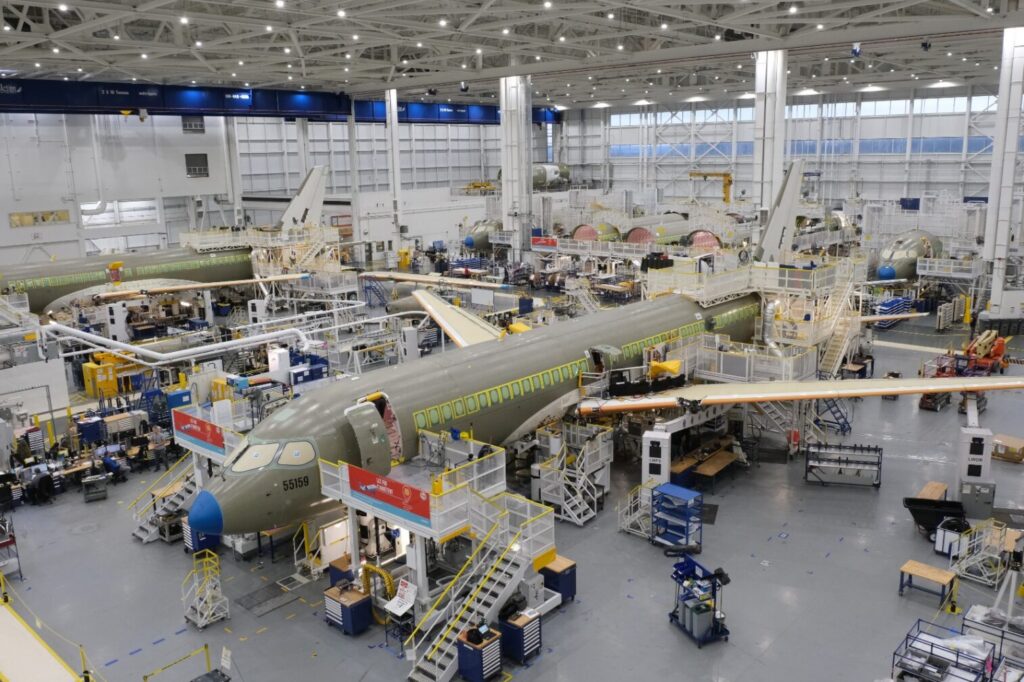
Image: Airbus A220 Assembly Line. Mirabel, QC. Canada
Split the Airbus/Boeing corporate-jet business in two and one half looks nothing like the other. This is Part 1 of a two-part series and covers the narrowbody half: Airbus Corporate Jets built on the ACJ narrowbody (A220 Two Twenty, A318/A319/A320/A321) and Boeing Business Jets built on the 737NG and 737 MAX platforms. Together they delivered 5 units in 2025 (5 ACJ narrowbody, zero BBJ/MAX), part of a run that has averaged 5.4 units a year over the last five years (2021-2025), a period that opened with a one-year rise to 8 units in 2021 before settling at 4 to 5 a year.
This is the more mature, higher-volume side of the ACJ/BBJ business, the direct size-and-price competitor to large-cabin jets from Bombardier (Global 7500/8000), Gulfstream (G800/G700) and Dassault (the upcoming Falcon 10X). On BCA’s Q1 2026 pricing (Aviation Week Purchase Planning Handbook), that positioning only partly holds: the ACJ TwoTwenty, at $82.5M, sits squarely inside the same band as the Global 8000 ($85M), G800 ($80.4M) and G700 ($84.9M) it competes against. But the larger narrowbody variants, the ACJ319neo ($107.5M), the ACJ320neo ($117M) and the BBJ MAX 7/8/9 ($97.5M to $124M), are priced meaningfully above that large-cabin band, not against it.
The Falcon 10X adds a fifth data point, though a moving one: its launch price, announced in 2021 and still the figure most sources quote today, was $75M. A more realistic estimate for its price in the 2029 certification and delivery year is likely in the $82M to $86M range, keeping it competitive with the Global 8000/G700/G800 band and in line with the $82.5M ACJ TwoTwenty.
Twenty-Five Years of a Steadily Thinning Market
Combining publicly disclosed industry information with JETNET data (as of October 13, 2026), ACJ narrowbody and BBJ/MAX production reached 23 units in 2006, dipped to 15 in 2008-2009 and peaked at 25 in 2010. It has been on a broad downward path since falling to 17 units in 2011 and then settling into a much thinner band. Since 2016, the combined total has not exceeded 8 units in a single year.
The composition has shifted too. In the 2000s (2000-2009), Boeing led in the blended data: it delivered 90 narrowbody units to Airbus’s 60 over the decade (roughly 3 to 2, or 60% of combined deliveries vs. 40%). From 2019 to 2025, Airbus’s ACJ TwoTwenty and A320neo-family aircraft have taken over as the larger of the two, delivering 29 units to Boeing’s 8, a reversal to roughly 3.6 to 1 in Airbus’s favor (78% vs. 22%).
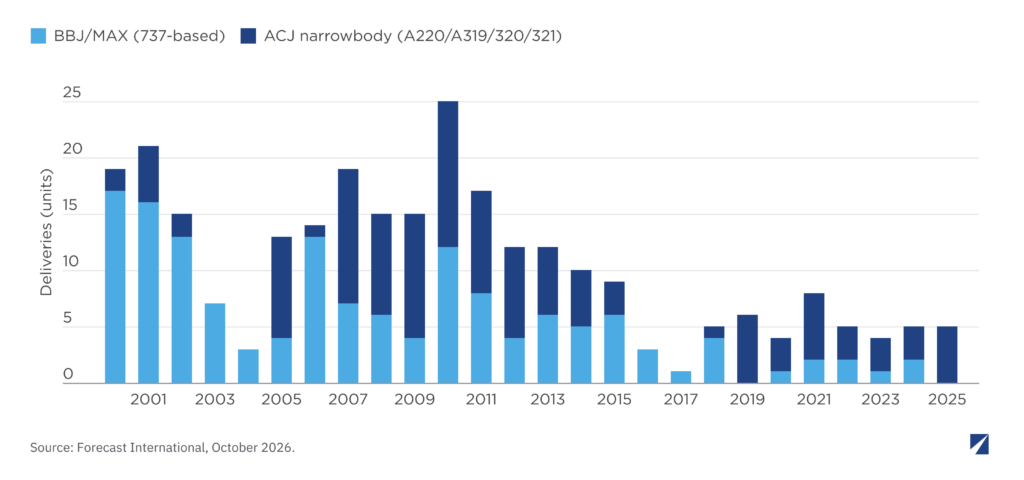
Chart 1. ACJ narrowbody and BBJ/MAX combined annual production, 2000-2025. Source: Publicly disclosed industry information and JETNET data.
A More Diverse Buyer Base Than Its Widebody Cousin
A study I took part in, commissioned in 2000 to size the European market for large and airliner-derivative corporate jets, explicitly covered the original A319CJ and BBJ and remains a useful reference point here because this narrowbody segment is the one that research actually described. Its three-way breakdown of buyers (governments, large corporations and executive charter operators) found government operators to be a small share, about 6% of the large and airliner-derivative fleet in Europe in 1999, with corporate flight departments (44%) and charter operators (50%) making up most of the customer base.
That distinction still matters. It means narrowbody ACJ/BBJ demand should track corporate and High Net Worth (HNW) wealth trends more closely than the widebody VIP segment does. However, the picture for recent new-build orders is more government-led, as the section on what the wealth-growth signal predicts explains.
Forecast Methodology
This model forecasts off a rolling five-year trailing average rather than backlog-driven growth rates, because neither Airbus nor Boeing discloses a backlog or book-to-bill figure for ACJ or BBJ. At volumes this small, where a single sovereign or corporate order can double a year’s total, a year-over-year percentage-growth framing would manufacture a false sense of precision. A multi-year average is therefore the more honest baseline.
Each forecast year’s average rolls forward to include the prior year’s forecast once it exists (so the 2027F average draws on 2022-2026 actuals/forecasts, 2028F on 2023-2027, and so on). Each year also carries an adjustment call, to be used only against a specific, confirmed order-pipeline signal and not as a speculative trend assumption.
For 2030, rather than a single point estimate, the model applies a downturn scenario: a 20% probability that a recession-level shock of 20% hits combined deliveries, blended with the 80%-probability no-recession case, to produce one probability-weighted headline figure. These inputs reflect this segment’s broader corporate/HNW buyer base being somewhat less exposed to a sharp pullback than the light/mid-size business jet market, but still less resilient than the sovereign-dominated widebody segment.
In practice, the 2026F-2029F figures move slowly and conservatively and will not swing sharply from year to year unless a real adjustment is entered. The 2030F figure, by contrast, is explicitly a blend of two futures rather than a forecast of what will happen. Because both the probability weight and the shock magnitude are judgment calls rather than disclosed figures, the 2030F number should be read as one reasonable scenario-weighted estimate, not a precise prediction, and it should be revisited whenever new evidence on either input emerges, for example a confirmed multi-aircraft order, a visible slowdown in completion-center activity or a shift in the macro backdrop for corporate and HNW capital spending.
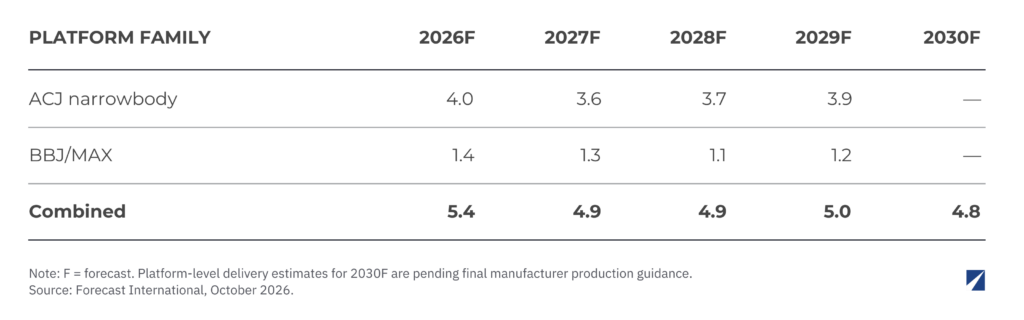
Table 1. ACJ Narrowbody and BBJ/MAX Production Forecast, 2026-2030. Author analysis.
As an upside scenario, a single confirmed large order entered as a pipeline adjustment in any forecast year would lift not just that year but every subsequent year’s trailing average. For example, a one-unit adjustment in 2026 raises the 2026F combined figure from 5.4 to 6.4 and modestly lifts 2027F-2029F as that higher actual rolls into their respective five-year windows. One such order is already public: in February 2025 an Abu Dhabi-based charter operator placed a firm order for three ACJ320neo. No delivery dates have been disclosed, so we have not added the aircraft to the forecast.
On the Boeing side, in May 2023 Boeing announced an order from undisclosed VIP customers for one BBJ 737-7. The 737-7 received FAA certification only in August 2026, with first deliveries expected in spring 2027, so this aircraft is not in the forecast either. If it ships in 2027, it would lift 2027F from 4.9 to 5.9 units and modestly raise 2028F-2029F as it rolls into the trailing average.
The same logic applies to spotting that upside before it shows up in delivery reports. Third-party completion centers that fit out narrowbody ACJ/BBJ green aircraft typically have order-pipeline visibility 18-36 months ahead of a reported delivery, the same leading-indicator role they play for the widebody segment. Tracking which centers are booking narrowbody ACJ/BBJ completion slots is a more current read on where this market is headed than last year’s unit total.
A first real-world check on this forecast arrived before this article went final: through the first half of 2026, 2 ACJ narrowbody units and 1 BBJ/MAX unit have been delivered. That is not a full-year actual, but a simple annualization (×2) points to roughly 4 ACJ narrowbody and 2 BBJ/MAX for the full year, tracking close to the 2026F forecast of 4.0 and 1.4 respectively, with BBJ/MAX running slightly ahead of its forecast pace. The model now carries this as a flagged interim data point, not yet folded into the trailing average, pending the year-end 2026 deliveries.
Where the Growth Actually Is
Because narrowbody demand draws on a broader corporate and HNW buyer base than the widebody segment, the broad-based wealth growth Knight Frank’s 2025 Wealth Report projects for 2024-2028F is, on its face, a directly relevant signal here. Knight Frank tracks this growth by counting individuals above set net-worth thresholds. For example, its “US$10m+ population” is the number of people worth US$10 million or more in a given region, a common wealth-based measure used alongside income and GDP.
On that basis, the number of US$10m+ individuals in Africa is forecast to grow 17.8% by 2028, more than triple the pace in North America (5.8%) or Europe (4.8%), with Latin America (9.7%) and Asia (8.7%) also outpacing the traditional demand centers.
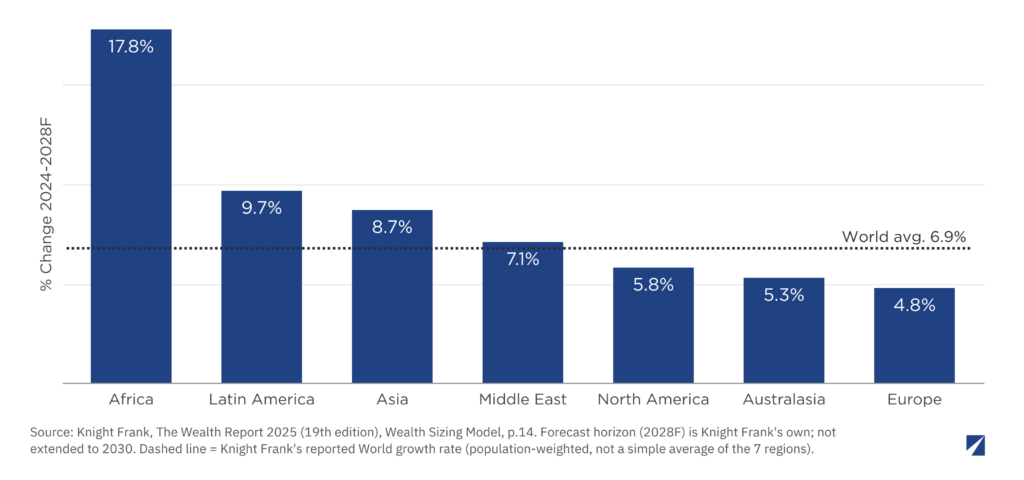
Chart 2. Growth in the Number of US$10 Million+ Individuals by Region, 2024-2028F, Wealth Sizing Model.
What the Wealth-Growth Signal Actually Predicts and Where It Doesn’t
The regional wealth-growth figures above measure private fortunes: the number of people worth US$10 million or more in each region. New-build narrowbody orders, though, appear to lean toward governments (heads of state, presidential fleets and state-owned flight departments); we have not tallied deliveries by buyer type. Private wealth and state procurement are two different demand pools, and conflating them overstates the signal in some regions and understates it in others.
The Middle East is where the signal holds up best, and its demand has two layers. The first is government and royal-family purchases, where a government-relations-led campaign fits. The second is operator-led, such as the Abu Dhabi-based charter operator that became a new Airbus customer with the February 2025 ACJ320neo order noted above.
Asia also appears to have an established base of repeat buyers, with evidence that points more toward commercial and private-sector operators. A corporate and charter-operator sales motion fits better there than a government-led one.
Europe is better read as an operator hub than as an end-buyer region. The ACJ TwoTwenty’s first orders came from a Switzerland-based charter operator, and the first aircraft it completed went to a buyer in the Middle East. Orders booked in Europe can therefore serve demand elsewhere, so where an aircraft is based and used matters more than where the order is signed.
Latin America is where the signal breaks down. Despite projected 9.7% growth in its private US$10m+ population, its new-build narrowbody history is limited and dated: two government A319CJs between 2001 and 2005, and we found no comparable order since. Its business jets run several years older than the global average and attempts to acquire presidential aircraft have gravitated to the pre-owned market because new-build pricing exceeded government budgets. Growing private wealth has not converted into new-aircraft orders, and there is no clear evidence the next five years break that pattern.
Africa sits in between. There is at least one recent example of a government taking delivery of a new narrowbody ACJ, but it reads as an isolated case, and at least one recent fleet renewal was filled with a secondhand aircraft. The 17.8% growth headline is the largest number on the chart, but the buying evidence behind it is thin: one recent new-build example does not make a trend.
Conclusion
The narrowbody half of the ACJ/BBJ market has spent the better part of fifteen years shrinking, from a peak of 25 units in 2010 to about 5 a year since 2022. Airbus’s A220- and A320neo-family ACJ line has taken over as the larger of the two programs, while Boeing’s BBJ/MAX line has been reduced to a handful of units a year. The newly certified 737-7, with one disclosed BBJ order, is the next test of whether that line can recover.
The segment’s broader corporate and HNW buyer base makes it more exposed to private wealth trends than the widebody segment, but recent new-build orders reach the manufacturers mainly through governments and through operators buying for private and corporate clients, so wealth growth converts into demand mainly where a government has a requirement or an operator is adding capacity.
Bottom line for where sales effort should go: the Middle East first, both government buyers and operators broadening their fleets, then Asia, with Europe as an operator-led channel. Africa is a watch list, not a near-term target: one recent new-build example is not yet a trend. Latin America is mainly a secondhand-market opportunity: its new-build history is limited and dated, so a new-build campaign makes sense only against a funded government program. Reading the wealth-growth numbers at face value, without that filter, would put Africa and Latin America ahead of the Middle East, the region most likely to deliver.
In Part 2 of this series, we will cover the widebody half: Airbus Corporate Jets built on the A330, A340 and A350 platforms (ACJ330-200/300/800, ACJ340, ACJ350-900) and Boeing’s widebody VIP line (747-8, 767, 777 and 787). That part also shows what Boeing’s 2023 order for two BBJ 787-8s and a BBJ 777-9 option would change in a segment Airbus has dominated since 2021.

René Armas Maes is a Strategic Advisor at Forecast International, where he leads the Airborne Retrofit & Modernization Forecast portfolio across commercial aviation, business aviation, helicopters, and military platforms.
He brings 20 years of international experience driving revenue growth, commercial strategy, and margin improvement across airlines, business aviation, charter operations, OEMs, and aviation services.
A published author with more than 175 articles and market analyses in AvBuyer, FlightGlobal, AeroTime, Forecast International, and REDD Intelligence, René writes on commercial strategy, aviation economics, fleet planning, business restructuring, market intelligence, and capital allocation, and maintains an active business aviation blog.
Throughout his career, he has held senior commercial leadership positions at Airbus, Textron Aviation, and IATA. Earlier, as a consultant with ICF Aviation/SH&E in New York, he advised airline and business aviation clients on strategy and restructuring initiatives including Kuwait Airways, Saudia Airlines, Flynas and RoyalJet Group in Abu Dhabi, UAE – a leading VVIP business aviation operator in the Middle East.