Deliveries Moderate Across Both Manufacturers in July // Airbus Orders Surge on Strong Farnborough Air Show Sales // Boeing 737 MAX Deliveries Show Stabilization
June 2026 Summary
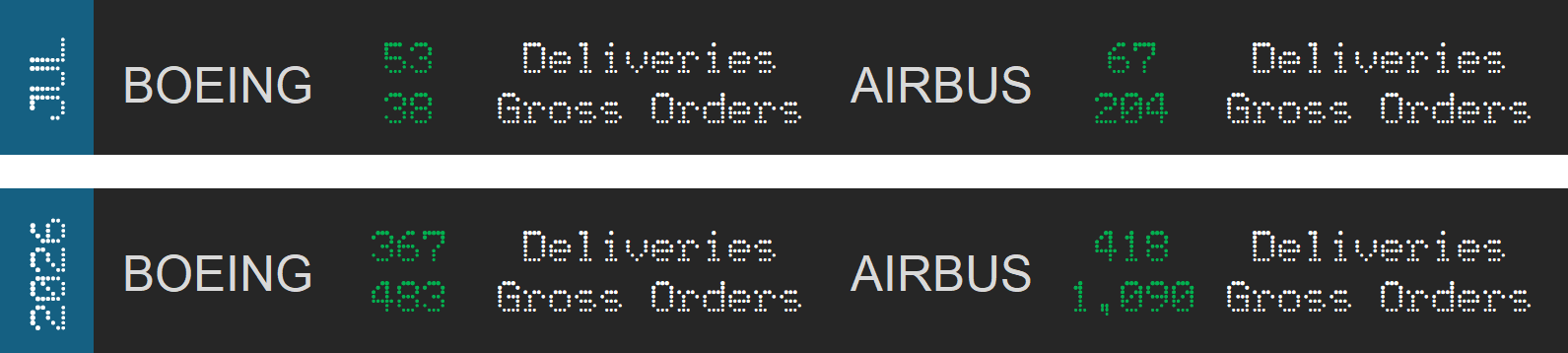
Commercial aircraft delivery and order activity remained dynamic in July 2026. Airbus delivered 67 commercial aircraft during the month, bringing its total 2026 deliveries to 418 aircraft out of a delivery target of 870 units in 2026. This extends the manufacturer’s lead over Boeing, which handed over 53 aircraft in July to reach a year-to-date total of 367 deliveries. While Airbus’s monthly delivery pace slowed significantly compared to June’s peak of 89, it maintains a 51-aircraft lead over Boeing through seven months of the year.
In the sales arena, Airbus surged ahead in July with 204 gross orders, rebounding strongly behind massive commitments for its single-aisle and widebody lines at the Farnborough Air Show. Boeing recorded a quieter month with 38 gross orders, evenly split between narrowbody and widebody jets. This performance pushed Airbus’s year-to-date order intake past the 1,000-aircraft threshold to 1,090 gross orders, widening its overall sales lead over Boeing to 607 aircraft.
Notes:
- A320neo numbers include all variants for the family; A319neo, A320neo and A321neo.
Boeing Deliveries
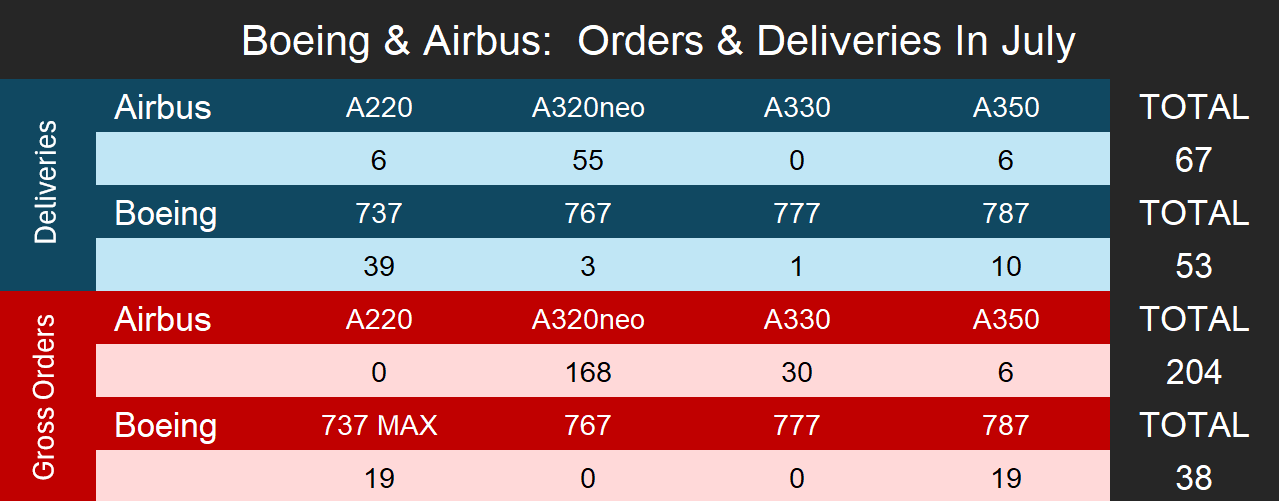
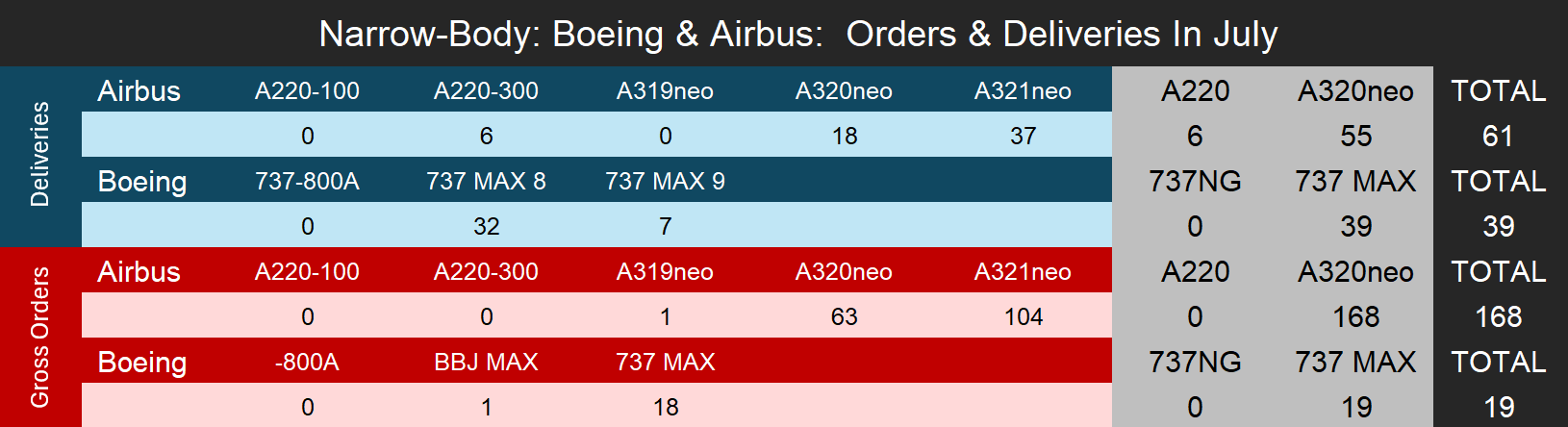
Boeing deliveries decreased in July, with only 53 commercial jets delivered during the month, compared to 64 in June. The single-aisle sector remained the primary driver with 39 737 MAXs delivered, a total that included 32 737 MAX 8s and seven 737 MAX 9s. While Boeing delivering 39 737 MAX aircraft in July is a strong sign that the program is stabilized, output has yet to officially transition to a steady 42-per-month rate. Deliveries have spiked near or above that cap on an intermittent basis, but consistent production and deliveries have been settling around the 38-per-month mark. Demonstrating consecutive months at or near the 42-aircraft threshold will be necessary before the program can officially be considered stabilized at that rate.
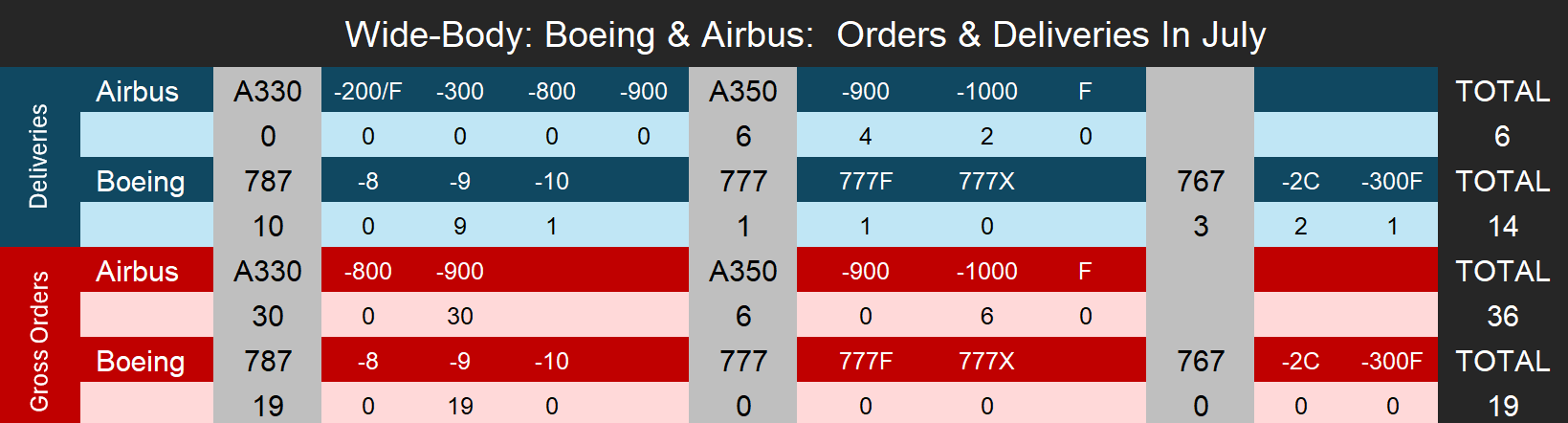
As for widebodies, Boeing delivered 14 twin-aisle aircraft in July, down from 21 in June. This segment consisted of 10 787 Dreamliners (comprising nine -9 variants and one -10 model), three 767s (comprising two -2C variants and one -300F), and a single 777 Freighter. Deliveries for the Dreamliner program continue to align with expectations as Boeing gradually works down its remaining inventory while production rates return to the current target rate of eight per month after struggling earlier in the year. While July’s results raised Boeing’s 2026 year-to-date deliveries to 367 aircraft, the U.S. manufacturer continues to trail its European rival by 51 aircraft.
Airbus Deliveries
Airbus registered a more modest month of output, delivering 67 jets in July following its year-to-date high of 89 aircraft in June. The narrowbody lineup drove the bulk of this activity with 61 single-aisle deliveries, which included 55 A320neo family aircraft (comprising 37 A321neos and 18 A320neos) along with six A220-300s. The widebody segment added six aircraft to the monthly total, all belonging to the A350 family, specifically four A350-900s and two A350-1000s. No A330 deliveries were recorded as production has struggled in recent months and remained well below the program’s current target rate.
By accumulating 418 total deliveries through the first seven months of the year, Airbus has cemented its delivery lead for 2026 over Boeing and remains well-positioned to work toward its annual delivery goal of approximately 870 aircraft. The manufacturer is also internally targeting an ambitious goal of 900 deliveries for the full year. At this stage, achieving such a high mark will be entirely dependent on the extreme fourth-quarter production ramp-up that typically characterizes Airbus’s year-end operations. Relying heavily on this late-year surge is especially necessary given that the manufacturer currently remains slightly behind the pace required to reach its official target of 870 aircraft.
Boeing Orders
Following stronger order intake in June, sales activity for Boeing moderated in July with 38 new gross commitments. The narrowbody segment captured half of this monthly demand, logging 19 commitments for the 737 line, which consisted of 18 737 MAX jets and one BBJ MAX executive aircraft. On the widebody side, Boeing matched its narrowbody intake by booking 19 gross orders for the 787 Dreamliner program, all for the 787-9 variant, while the 767 and 777 programs saw no new sales activity during the month. Although these additions pushed Boeing’s year-to-date gross orders to 483 aircraft through July 31st, the U.S. manufacturer continues to trail Airbus substantially, with its European rival holding more than double Boeing’s total order volume for the year.
- For consistency, this article does not include Boeing’s ASC 606 accounting adjustments and considers net orders as gross orders minus cancellations.
Airbus Orders
Rebounding sharply after a quieter June, Airbus saw its order intake accelerate to 204 gross commitments in July, driven primarily by strong commercial demand at the Farnborough Airshow. This was led by the single-aisle market, which booked 168 narrowbody orders for the A320neo family, comprised of 104 A321neos, 63 A320neos, and a single A319neo. The widebody segment also added aircraft but to a lesser extent, with 36 gross orders made up of 30 A330-900neos and six A350-1000s, while the A220 program logged no new orders during July. Together, these new additions brought Airbus’s 2026 gross orders to 1,090 aircraft through July 31st, a milestone total that comfortably expands its lead over Boeing and has further expanded its backlog.
Backlog
- Airbus backlog numbers do not include A320ceo ghost orders.
- Boeing backlog numbers do not include 777-300ER ghost orders.
- A320neo numbers include all variants for the family; A319neo, A320neo and A321neo
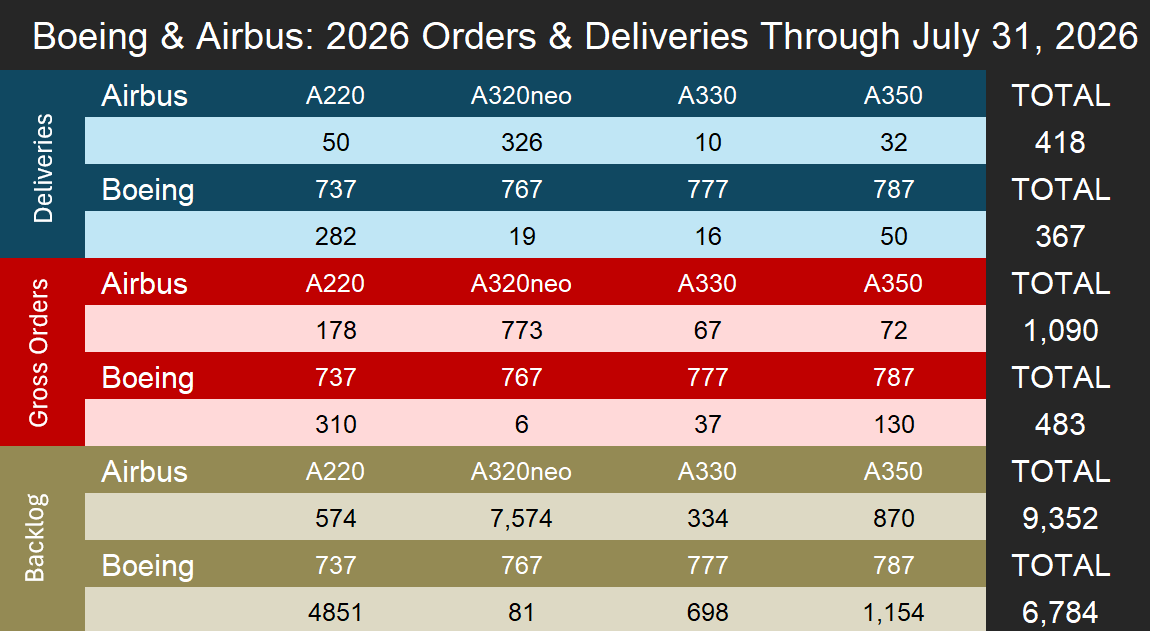
Fueled by its order momentum, Airbus saw its order book expand to 9,352 commercial aircraft at the end of July 2026. This performance marks a net gain of 136 units from the prior month, driven by a surge in new sales that comfortably outpaced monthly deliveries. Narrowbodies continue to dominate the manufacturer’s total backlog, with the A320neo family accounting for 7,574 outstanding orders alongside 574 commitments for the smaller A220 program. On the widebody side of the business, Airbus maintains long-term depth with 1,204 twin-aisle aircraft in its queue, a total comprising 870 firm commitments for the A350 and 334 for the A330. This total backlog translates to roughly 10.7 years of steady manufacturing coverage when measured against the company’s current annual delivery target of approximately 870 aircraft.
In contrast, Boeing’s total commercial backlog experienced a minor contraction, settling at 6,784 aircraft as July came to an end. This outcome reflects a slight net drop of 30 units from June, as monthly delivery volume outstripped new gross order intake. The foundation of Boeing’s order book remains the narrowbody segment, which is anchored by 4,817 outstanding commitments for the 737 MAX and 34 for the legacy 737NG program. The widebody portfolio accounts for 1,933 units of the remaining aircraft, led by 1,154 orders for the 787 Dreamliner, 698 for the 777 family, and 81 for the 767 platform. Under current production rates and projected delivery speeds, this overall order backlog provides the U.S. manufacturer with approximately 10.1 years of production coverage.
To get a more detailed, month‑by‑month breakdown of commercial aircraft OEM activity, including production, orders, and delivery execution risk, visit https://figlobalintelligence.com/commercial-aircraft-oem-intelligence-brief/

With diverse experience in the commercial aviation industry, Grant joins Forecast International as the Lead Analyst for Commercial Aerospace. He began his career at the Boeing Company, where he worked as a geospatial analyst, designing and building aeronautical navigation charts for Department of Defense flight operations.
Grant then joined a boutique global aviation consulting firm that focused on the aviation finance and leasing industry. In this role he conducted valuations and market analysis of commercial aircraft and engines for banks, private equity firms, lessors and airlines for the purposes of trading, collateralizing and securitizing commercial aviation assets.
Grant has a deep passion for the aviation industry and is also a pilot. He holds his Commercial Pilots License and Instrument Rating in addition to being a FAA Certified Flight Instructor.