Production Rebounds to New High in September /// Widebody Inventory Remains Elevated Despite Lower Lead Times /// Deliveries Increase as 4Q Push Begins

Boeing Everett Factory. Image – Boeing
Production by Market Segment
The data in this summary is derived from our Commercial Aircraft OEM Intelligence Brief and only offers a broad overview of the commercial aircraft industry by market segment. For in-depth OEM- and program-specific analysis that incorporates these performance indicators to evaluate the health and execution of commercial aircraft manufacturers, explore the full Commercial Aircraft OEM Intelligence Brief.
Commercial aircraft manufacturing rebounded in September 2026, with total output rising to 146 units from 131 in August and surpassing July’s previous recent high of 137 aircraft. The gain was broad-based across the two largest segments. Narrowbody production recovered to 113 units, up from 105 in August and back in line with the 113 units built in July, as the segment regained the momentum it lost the previous month. The 737 MAX program continued to serve as a stable source of production in September, while the A320neo program’s recent difficulty in consistently reaching its target rate of 50 aircraft per month remains the key variable to watch heading into the fourth quarter. Widebody production also improved, climbing to 24 units after holding at 20 in July and August, though output remains below expected rates as Airbus widebody programs continue to face persistent challenges. Among the smaller sectors, regional jet production jumped to seven aircraft from just two in August, while turboprop output fell by half to two units after doubling the prior month. Through the first nine months of 2026, total production reached 1,141 aircraft. Narrowbodies remain the clear driver of global output at 911 units year-to-date, followed by 178 widebodies, while regional jets and turboprops account for the remaining 32 and 20 units, respectively.
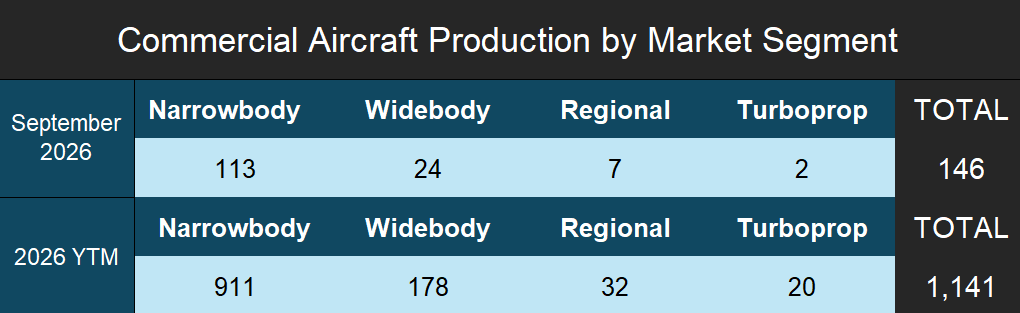
- Production data represents the actual number of aircraft produced in September 2026. Forecast International considers an aircraft produced upon its first flight. This may differ from an OEM’s definition of produced.
Inventories by Market Segment
As of September 30, 2026, total commercial aircraft inventory stood at 124% of combined monthly production target rates across all major market segments, meaning manufacturers are holding roughly one and a quarter months’ worth of targeted output in completed but undelivered aircraft. Narrowbody inventory sat at 108% of target rates, the lowest relative level of any segment, though the figure continues to be weighed down by MAX 7 and MAX 10 airframes that are not expected to deliver until 2027. On the other hand, widebody inventory was considerably more elevated at 158% of current production target rates, reflecting continued delays that are being caused by cabin interior and seating bottlenecks. The smaller segments carried the highest relative inventory levels, with regional jets at 240% and turboprops at 233% of their respective target rates, though these percentages are amplified by the comparatively low monthly production rates in both sectors.

- Inventories represent the number of aircraft that have completed their first test flight but have not been delivered to the customer. Aircraft progressing through the final assembly line that have not completed their first test flight are not considered inventory.
Average Production-to-Delivery Lead Times
The overall average time from first flight to contract delivery across all market segments fell to 33 days in September 2026, a significant improvement from 45 days in August, driven largely by a sharp reduction in widebody lead times. Widebody aircraft averaged just 28 days from production to delivery, less than half of August’s 59-day average and well below July’s inventory-distorted figure of 207 days, suggesting fewer long-stored airframes were included in the month’s delivery mix. However, widebody inventory levels remain elevated, signaling that lead times are likely to increase in the coming months as remaining stored airframes are drawn down.

Narrowbody lead times remained steady at 25 days, essentially unchanged from the 24 days recorded in both July and August and continuing the improvement seen since May’s 34-day average. This trend has been driven by declining inventory levels, as both Airbus and Boeing delivered newly produced aircraft to customers far more efficiently in the third quarter than in the second. As for the remaining sectors, Turboprop programs averaged 46 days, down from 52 days in August, and no regional jet lead time was recorded for the month due to a lack of paired production and delivery events.
Projected Deliveries
Our September delivery tracking indicates that major global OEMs delivered a combined 142 aircraft during the month, a strong rebound from the 108 aircraft delivered in August and a reversal of the declining trend seen over the summer. Airbus led the increase, with projected deliveries climbing to 67 aircraft from 49 the prior month. The A320neo family accounted for the majority of this total with an estimated 53 deliveries, up from 39 in August, alongside eight A220s, five A350s, and a single A330neo. We expect Boeing to report a slight increase to approximately 56 total deliveries, up from 53 in the previous month, led by 43 737 MAX aircraft. Boeing’s widebody deliveries edged up to 13 units from 12 in August, with eight 787 Dreamliners, three 767s, and two 777s, as stronger 787 output more than offset a decline in 767 deliveries. Regional manufacturers also contributed meaningfully to the month-over-month gain. Embraer deliveries increased significantly to approximately 15 aircraft, up from just three in August, comprising six E175s, six E195-E2s, and three E190-E2s. ATR delivered four ATR 72-600s, while COMAC again recorded no deliveries across its C909 and C919 programs.
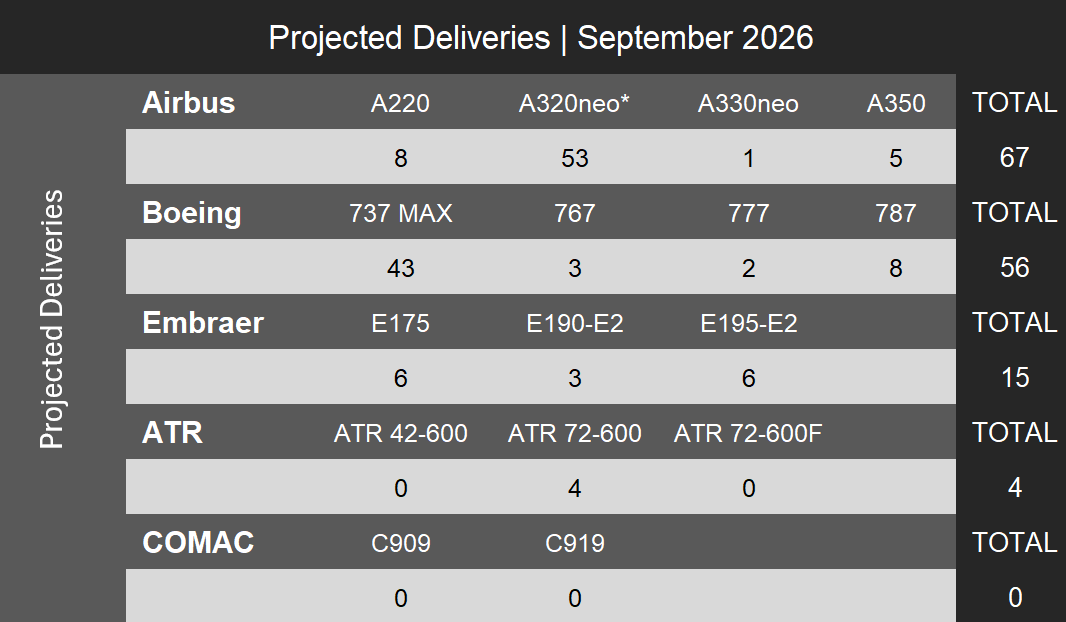
- Deliveries summary is based on Forecast International’s internal research. Numbers are not official and are not provided by the manufacturer.
- A320neo numbers include all variants for the family; A319neo, A320neo and A321neo

With diverse experience in the commercial aviation industry, Grant joins Forecast International as the Lead Analyst for Commercial Aerospace. He began his career at the Boeing Company, where he worked as a geospatial analyst, designing and building aeronautical navigation charts for Department of Defense flight operations.
Grant then joined a boutique global aviation consulting firm that focused on the aviation finance and leasing industry. In this role he conducted valuations and market analysis of commercial aircraft and engines for banks, private equity firms, lessors and airlines for the purposes of trading, collateralizing and securitizing commercial aviation assets.
Grant has a deep passion for the aviation industry and is also a pilot. He holds his Commercial Pilots License and Instrument Rating in addition to being a FAA Certified Flight Instructor.