Narrowbody Output Moderates After Year-End Surge /// Widebody Activity Remains Concentrated /// Contractual Timing Shapes Early-Year Deliveries

Boeing 737 MAX FAL – Image – Boeing
For readers seeking deeper program-level insight, including detailed production trajectories, delivery risks, and program-specific analysis, Forecast International offers a Monthly Commercial Aircraft OEM Intelligence Brief that provides granular breakdowns by aircraft program and variant. To request a sample edition, contact sales@forecastinternational.com
Production by Market Segment
NOTE: For the purposes of this article, Forecast International considers an aircraft to be “produced” once it completes its first test flight, and “delivered” when it is contractually handed over to the customer.
Total commercial aircraft production in January 2026 reached 93 aircraft, reflecting a seasonal moderation following elevated year-end output. Production remained heavily concentrated in the narrowbody segment, which accounted for 76 aircraft, reinforcing the continued prioritization of single-aisle programs across global final assembly lines. Widebody production totaled 16 aircraft during the month, indicating relatively steady activity but continuing to reflect the uneven pace of recovery across long-haul platforms compared to narrowbodies. Turboprop production was limited to one aircraft, while no regional jets were recorded as produced during January, resulting in minimal contribution from these segments to overall production totals at the start of the year.
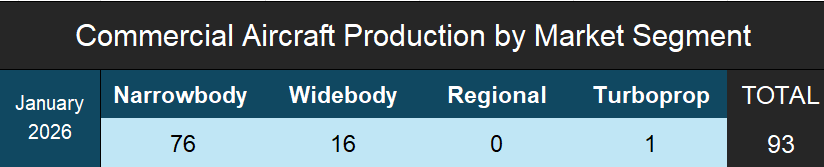
- Production data represents the actual number of aircraft produced in January 2026. Forecast International considers an aircraft produced upon its first flight. This may differ from an OEM’s definition of produced.
Average Production-to-Delivery Lead Times
Average lead times from production to delivery lengthened modestly in January compared to December, reflecting a normalization of delivery activity following the concentrated year-end push. Narrowbody aircraft recorded an average lead time of 28.8 days, while widebodies averaged 33.5 days, indicating a slower handover cadence as OEMs reset delivery pipelines entering the new year. Regional jet and turboprop lead times are not reported for January since ATR and COMAC did not both produce and deliver aircraft during the month, while Embraer is excluded from the lead-time analysis due to obscured ADS-B data, which prevents reliable identification of production events.

Projected Deliveries
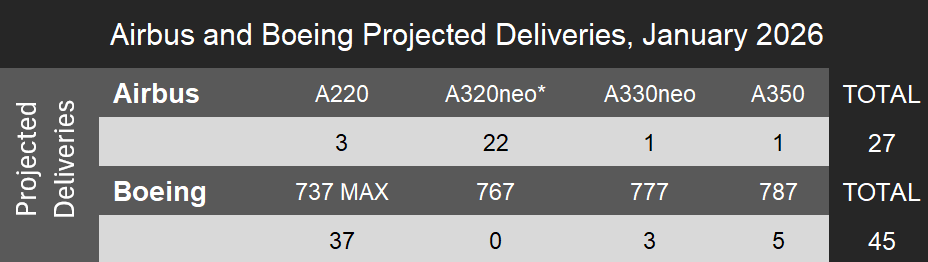
Forecast International estimates that Airbus and Boeing combined delivered approximately 72 aircraft in January 2026, a level consistent with a typical post–year-end slowdown and influenced heavily by contractual delivery timing.
Forecast International estimates that Airbus delivered 27 aircraft during the month. Narrowbody deliveries were led by the A320neo-family with 22 aircraft, alongside three A220s. Widebody deliveries were limited to one A330neo and one A350. The comparatively low Airbus delivery total in January primarily reflects the aggressive year-end delivery push executed in December and the contractual definition of delivery applied in this analysis. A significant number of aircraft that were contractually delivered on December 31st to support year-end performance metrics were physically ferried to their operators throughout January. As a result, December delivery figures were elevated, while January totals appear reduced when measured strictly by contractual handover date rather than physical aircraft movement. Boeing deliveries totaled an estimated 45 aircraft in January. The 737 MAX accounted for 37 deliveries, continuing to anchor Boeing’s delivery profile early in the year. Widebody activity included three 777s and five 787s, while no 767 deliveries were recorded during the month.
Notes:
- Delivery data is the expected number that Boeing and Airbus will report in their January 2026 Orders and Deliveries summary and is based on Forecast International’s internal research. Numbers are not official and are not provided by Airbus or Boeing.
- A320neo numbers include all variants for the family; A319neo, A320neo and A321neo
- 737 numbers include 737-800A and 737 MAX variants

With diverse experience in the commercial aviation industry, Grant joins Forecast International as the Lead Analyst for Commercial Aerospace. He began his career at the Boeing Company, where he worked as a geospatial analyst, designing and building aeronautical navigation charts for Department of Defense flight operations.
Grant then joined a boutique global aviation consulting firm that focused on the aviation finance and leasing industry. In this role he conducted valuations and market analysis of commercial aircraft and engines for banks, private equity firms, lessors and airlines for the purposes of trading, collateralizing and securitizing commercial aviation assets.
Grant has a deep passion for the aviation industry and is also a pilot. He holds his Commercial Pilots License and Instrument Rating in addition to being a FAA Certified Flight Instructor.