Production Cools Following July Strength /// Narrowbody Inventory Normalizes Amid Production Step-Back /// Deliveries Slow Ahead of 4Q Push
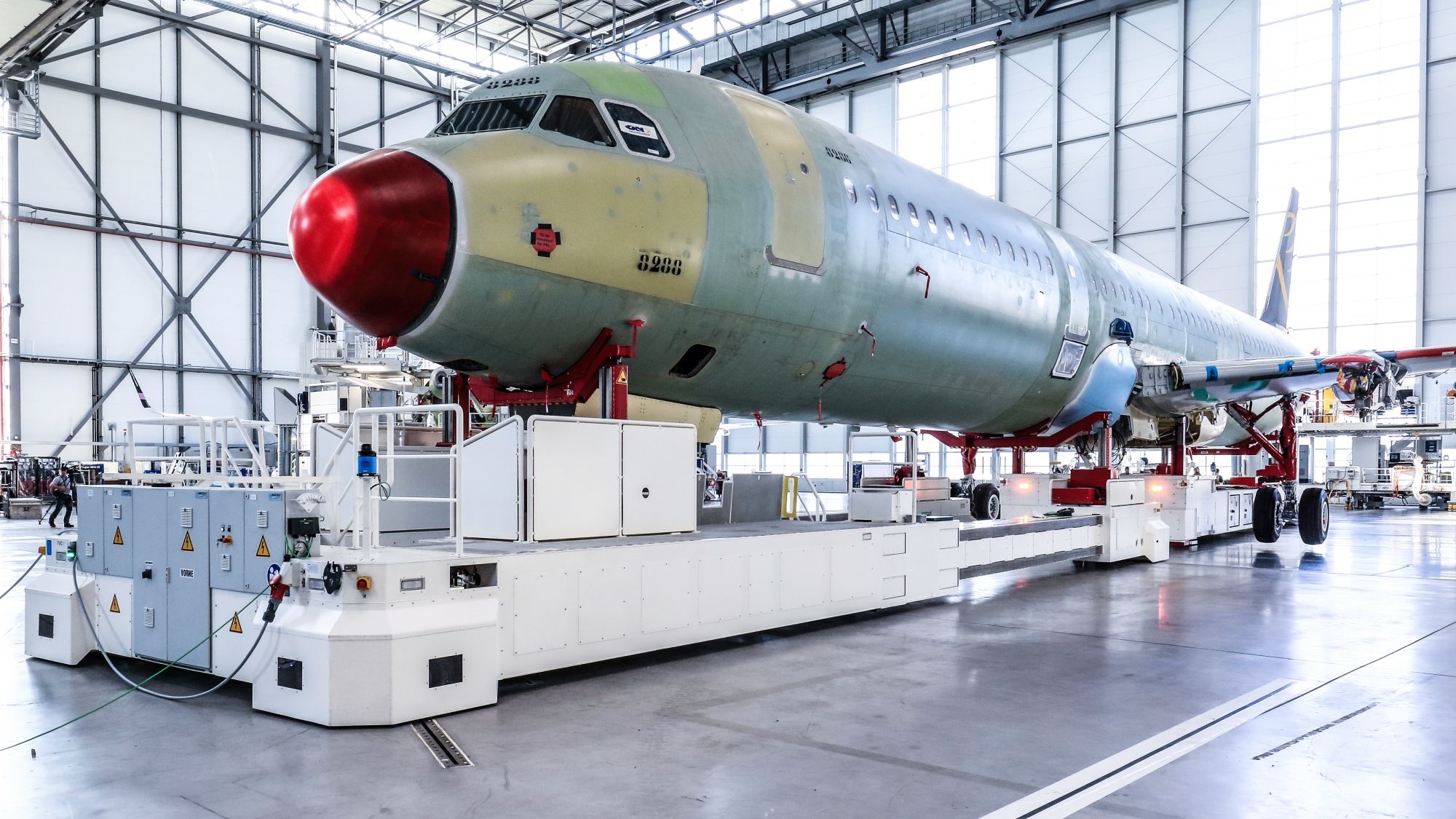
Airbus A320neo Family FAL – Image – Airbus
Production by Market Segment
The data in this summary are derived from our Commercial Aircraft OEM Intelligence Brief and only offer a broad overview of the commercial aircraft industry by market segment. For in-depth OEM and program-specific analysis that incorporates these performance indicators to evaluate the health and execution of commercial aircraft manufacturers, explore the full Commercial Aircraft OEM Intelligence Brief.
Overall, commercial aircraft manufacturing remained relatively stable in August 2026, experiencing only a slight month-over-month drop from July to 131 units following a steady three-month climb that saw production rise from 126 aircraft in May to 132 in June and 137 in July. Narrowbody production primarily drove this slight deceleration, with output decreasing to 105 units in August after reaching 113 in July and 109 in June. The step-back stems from ongoing instability in the A320neo program, which has struggled to consistently exceed its current target rate of 50 aircraft per month. On the other hand, the 737 MAX program continues to provide a stable foundation for the single-aisle market and has experienced little to no volatility. Meanwhile, widebody production remained steady but well below expected rates, largely due to persistent challenges across Airbus widebody programs. This was demonstrated by the 20 units completed during August, showing no improvement over July’s 20 units and only a slight gain over the 19 units completed in both May and June. Across the smaller sectors, regional jet manufacturers completed two aircraft during August, holding perfectly flat compared to July, while turboprop output doubled month-over-month to four units. Looking at the broader industry trajectory, total year-to-date (YTD) production reached 995 aircraft through the first eight months of 2026. Narrowbodies continue to dominate global output with 798 units built year-to-date, compared to 154 widebody aircraft completed. Regional jets and turboprops represent the remainder of YTD output at 25 and 18 units, respectively.
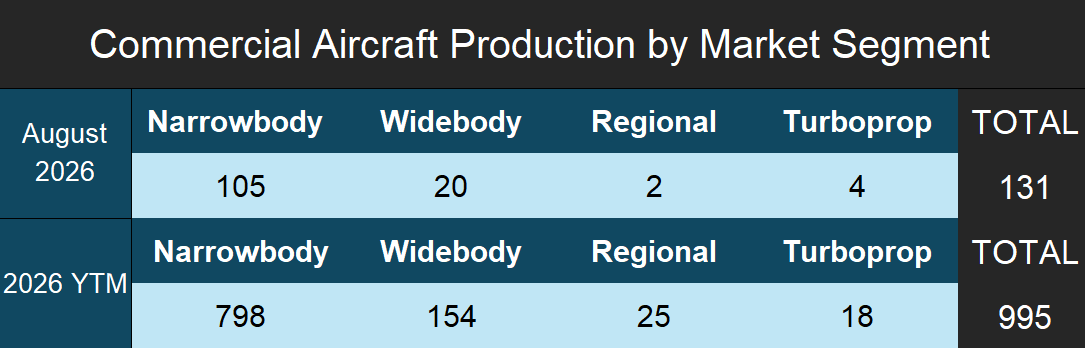
- Production data represents the actual number of aircraft produced in August 2026. Forecast International considers an aircraft produced upon its first flight. This may differ from an OEM’s definition of produced.
Inventories
As of August 31, 2026, total commercial aircraft inventory across all major market segments stabilized, gradually declining from its second-quarter peak as manufacturers relied on stored aircraft to meet delivery schedules. At the end of August, inventory stood at 25% above the combined current production target rates for all commercial programs, with narrowbodies accounting for nearly 70% of the total. This high narrowbody volume is driven primarily by accumulated 737 MAX inventory, specifically MAX 7 and MAX 10 airframes requiring extensive post-production rework. Because these airframes are unlikely to be delivered before 2027, we expect that overall narrowbody inventory may remain elevated well into next year. Meanwhile, widebody inventory remained high at month-end, heavily impacted by stored airframes awaiting resolution of cabin interior and seating bottlenecks or needing significant rework due to being produced several years ago.
Average Production-to-Delivery Lead Times
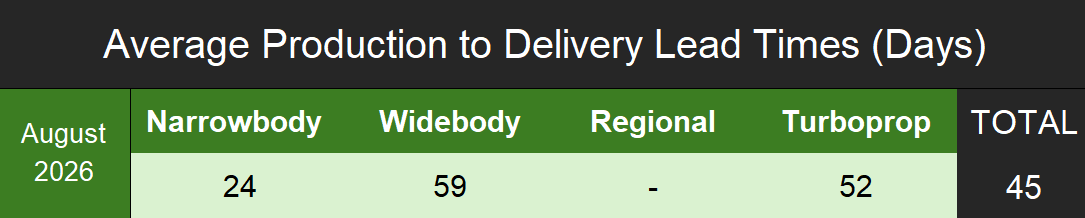
During August 2026, the overall average timeline spanning initial production to final contract delivery across all market segments stood at 45 days, heavily driven by figures in the widebody sector. On the contrary, single-aisle programs maintained a healthy operational flow, with narrowbody lead times averaging 24 days, matching the 24-day average achieved in July and demonstrating continued progress over the 27 days recorded in June and 34 days in May. While widebody lead times remain elevated compared to historical levels, they decreased significantly in August to an average of 59 days, representing a normalization from July’s inventory-distorted spike of 207 days and returning closer to the 68 days recorded in June and 20 days in May. Finally, turboprop programs logged an average lead time of 52 days from first flight to contractual delivery during the month, something that is typical of the sector and not a cause for concern.
Projected Deliveries
According to our August delivery tracking, major global OEMs delivered a combined total of 108 aircraft during the month, marking a continued decline from the levels recorded in July and June. As anticipated, this overall market decline was primarily driven by lower deliveries from Boeing and Airbus, while projected deliveries for Embraer, ATR, and COMAC remained flat or negligible, making them non-factors in the month-over-month drop. Rather than a temporary anomaly, this lower delivery volume reflects a broader shift across the industry. Because production rates have not significantly improved and manufacturers have largely drawn down the high levels of stored inventory previously used to support deliveries, the delivery of aircraft can no longer be artificially supported by inventory levels, leaving monthly delivery totals now more directly tied to assembly line output.
This tight alignment between production and delivery is especially evident across both narrowbody and widebody lines, where deliveries are moving in close lockstep with assembly output as ongoing cabin interior bottlenecks and engine supply constraints limit overall delivery volumes. Airbus accounted for an estimated 49 total aircraft deliveries in August, led by 39 A320neo family aircraft and seven A220s, while widebody deliveries slowed to just two A350s and a single A330neo. On the other hand, we expect Boeing to report approximately 53 total deliveries for the month, led by 41 737 MAX deliveries alongside 12 widebody units, which comprised six 767s, four 787 Dreamliners, and two 777s. Across regional manufacturers, projected deliveries remained low, with Embraer delivering only three aircraft (two E175s and one E190-E2), matching ATR’s three deliveries (all ATR 72-600s), while COMAC recorded zero deliveries across both its C909 and C919 programs.
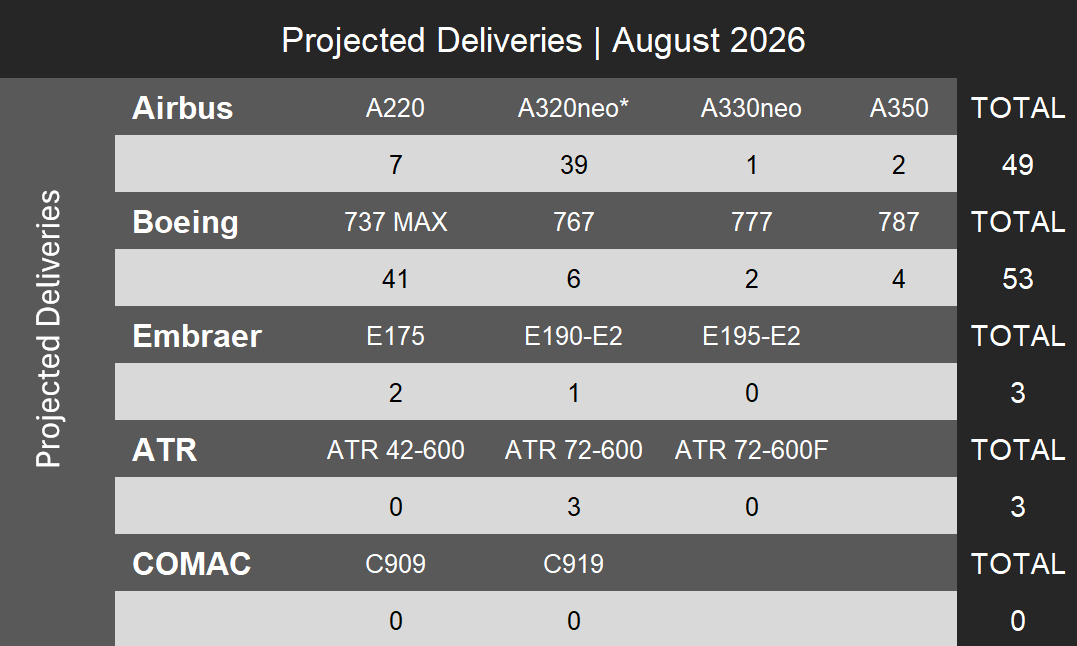
- Deliveries are based on Forecast International’s internal research. Numbers are not official and are not provided by the manufacturer.
- A320neo numbers include all variants for the family; A319neo, A320neo and A321neo

With diverse experience in the commercial aviation industry, Grant joins Forecast International as the Lead Analyst for Commercial Aerospace. He began his career at the Boeing Company, where he worked as a geospatial analyst, designing and building aeronautical navigation charts for Department of Defense flight operations.
Grant then joined a boutique global aviation consulting firm that focused on the aviation finance and leasing industry. In this role he conducted valuations and market analysis of commercial aircraft and engines for banks, private equity firms, lessors and airlines for the purposes of trading, collateralizing and securitizing commercial aviation assets.
Grant has a deep passion for the aviation industry and is also a pilot. He holds his Commercial Pilots License and Instrument Rating in addition to being a FAA Certified Flight Instructor.