How did the Boeing 787 go from a poorly performing program at the beginning of 2025 to exceeding expectations and stabilizing at 8 per month, to now struggling again?
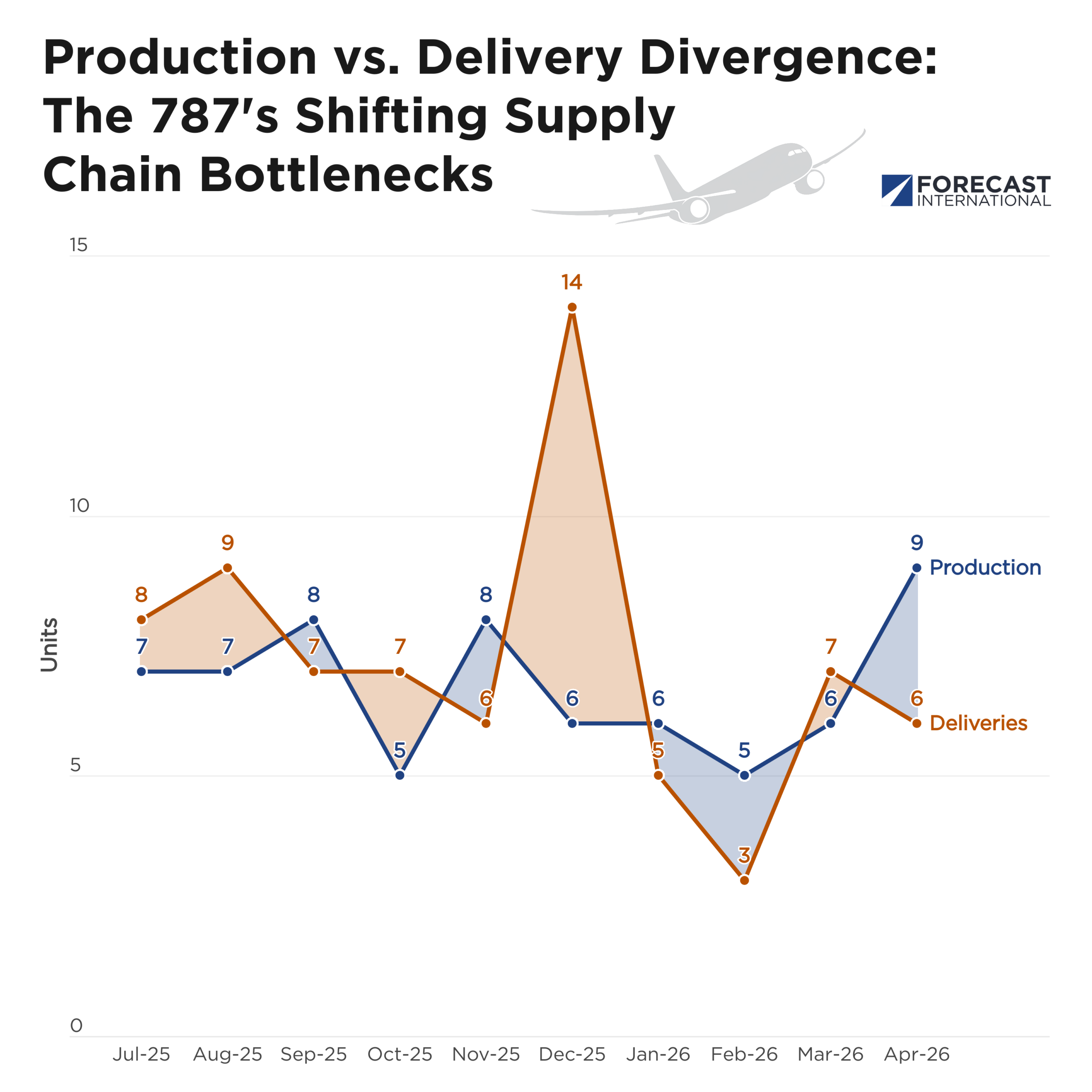
The answer lies in a constantly shifting bottleneck across the supply chain, with data from our latest Commercial Aircraft OEM Intelligence Brief highlighting an ongoing disconnect between 787 assembly line output and actual delivery rates. While the program showed strong momentum during the second half of 2025, actual production numbers started to slip below the target rate of 8 aircraft per month during the first quarter of 2026. This initial drop was driven heavily by engine delays from the GEnx program, though deliveries initially maintained track during this period because Boeing was able to clear out existing, stored inventory.
The good news is that those engine delays are showing signs of easing and translating directly to improved production, as exemplified by output returning back toward the target rate of 8 per month recently. But even as production numbers recover, delivery rates continue to lag production throughout 2026 due to issues pertaining to premium business class seating. Much like the MAX last year, Boeing can no longer rely on stored inventory to support its delivery rates. Because of this, we expect the current seating bottleneck will continue to cause delivery rates to lag production levels for the foreseeable future, creating an ongoing source of instability for the program.
So why is this important? The 787 is expected to account for the second-most deliveries of any platform in 2026, sitting right behind the 737 MAX at 15.4% of Boeing’s total annual deliveries. Because of this, the health of the Dreamliner program will fundamentally determine Boeing’s ability to meet its broader corporate goals and our own delivery forecast for the year, which directly drives revenue for its commercial airplanes segment. Additionally, because these headwinds signal potential risk to the 787 supply chain, suppliers may hesitate to expand capacity, which would stall Boeing’s plans to stabilize production at 10 aircraft per month.
To look past the broad market headlines and access the deep data, lead times, and underlying supply chain nuances that OEM press releases overlook, access our full Commercial Aircraft OEM Intelligence Brief here: https://figlobalintelligence.com/commercial-aircraft-oem-intelligence-brief/

With diverse experience in the commercial aviation industry, Grant joins Forecast International as the Lead Analyst for Commercial Aerospace. He began his career at the Boeing Company, where he worked as a geospatial analyst, designing and building aeronautical navigation charts for Department of Defense flight operations.
Grant then joined a boutique global aviation consulting firm that focused on the aviation finance and leasing industry. In this role he conducted valuations and market analysis of commercial aircraft and engines for banks, private equity firms, lessors and airlines for the purposes of trading, collateralizing and securitizing commercial aviation assets.
Grant has a deep passion for the aviation industry and is also a pilot. He holds his Commercial Pilots License and Instrument Rating in addition to being a FAA Certified Flight Instructor.