Narrowbody Production Maintains Momentum /// Widebody Lead Times Surge on Inventory Clearances /// Deliveries Likely to Stabilize Following June Peaks

For the purposes of this article, Forecast International considers an aircraft to be “produced” once it completes its first test flight, and “delivered” when it is contractually handed over to the customer.
Production by Market Segment
Commercial aircraft manufacturing saw a slight increase in July 2026, climbing to 137 units following 132 aircraft produced in June and 126 in May. Narrowbody production drove this slight increase, with OEMs producing 113 narrowbody aircraft compared to 109 units in June. This stabilization and slight increase were driven by high-rate narrowbody programs such as the A320neo and 737 MAX continuing to stabilize at or above their current target rates. However, output did not see a significant increase, as both Airbus and Boeing are now approaching peak production periods for 2026; the third quarter traditionally marks the beginning of a significant surge in total annual production and deliveries compared to the lower volumes seen in Q1 and Q2. Meanwhile, widebody production posted a slight increase to 20 units, compared to the 19 units completed in both May and June. Within the smaller sectors, regional jet manufacturers completed two aircraft, matching the two units produced by the turboprop segment. Looking at the broader industry performance through July, total year-to-date production has reached 863 aircraft over the first seven months of the year. Narrowbodies continue to dominate overall production with 693 units built, compared to 134 widebody aircraft completed, while regional aircraft and turboprops are tracking at 22 and 14 units through the end of July, respectively.
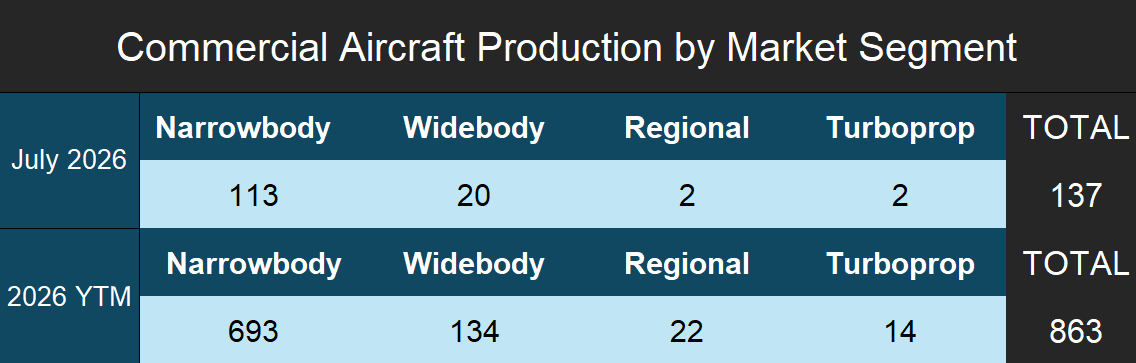
- Production data represents the actual number of aircraft produced in July 2026. Forecast International considers an aircraft produced upon its first flight. This may differ from an OEM’s definition of produced.
Average Production-to-Delivery Lead Times
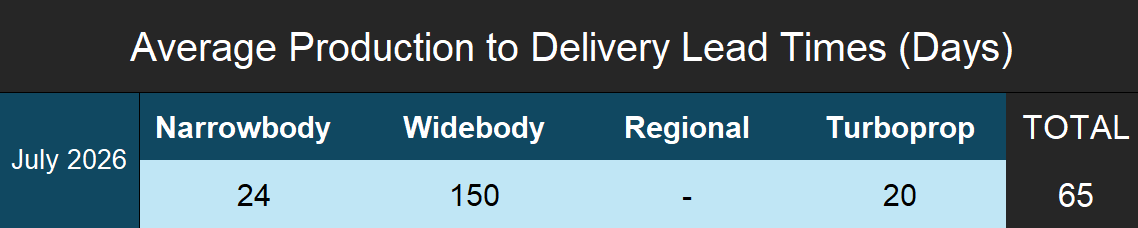
During July, the average timeline spanning initial production to final contract delivery varied significantly across market segments. Narrowbody operational bottlenecks continued to ease as average production-to-delivery lead times dropped to 24 days, marking a 3-day improvement over June’s 27-day average and standing well below the 34 days recorded in May. Much of this progress stems from recent efficiency gains across the A320neo family assembly lines, whereas the 737 MAX program has maintained a stable and healthy operational flow.
Conversely, widebody lead times surged dramatically to an average of approximately 150 days, rising sharply from 68 days in June and just 20 days in May. This substantial spike was primarily driven by the delivery of long-stored 787 inventory dating as far back as 2020, which distorted the overall average. When excluding these specific aircraft, freshly produced 787s averaged just 17 days from production to delivery, demonstrating that aircraft coming straight off the assembly line are moving efficiently. The A350, on the other hand, continues to encounter headwinds with an average lead time of 42 days, even without accounting for stored inventory, which sits well above the 30-day threshold we consider healthy for a widebody program.
Projected Deliveries
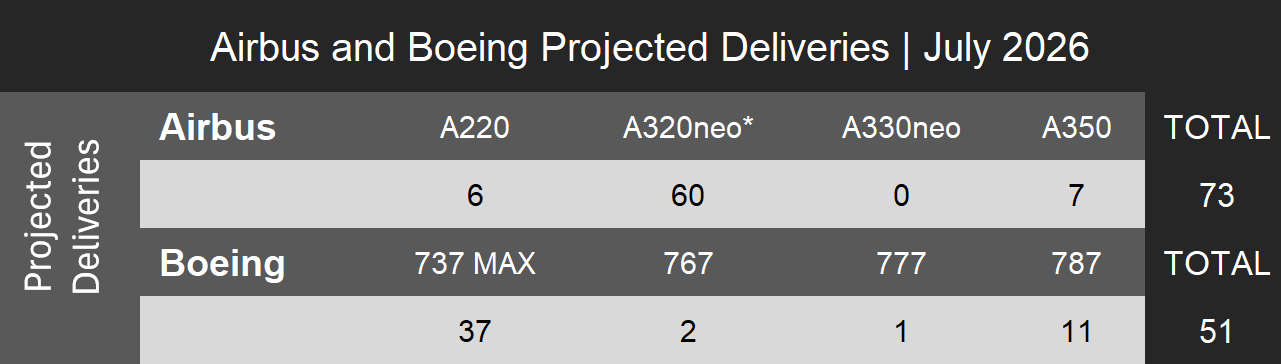
According to July delivery tracking from Forecast International, Airbus and Boeing delivered an estimated 124 aircraft combined during the month, slowing down from the 136 units handed over across June.
Airbus accounted for 73 aircraft of this total, marking a decrease from the 89 deliveries recorded in June. On the narrowbody side, the A220 line experienced a minor dip, delivering six aircraft compared to eight in both May and June. Meanwhile, the core A320neo family continued to drive the bulk of Airbus’s delivery volume, contributing 60 aircraft. Across widebody programs, results showed slight signs of improvement for the A350, which rose to seven deliveries in July compared to five in June and four in May. Conversely, the A330neo line remained stagnant, logging zero deliveries for the second consecutive month as production rates continue to lag. While official monthly figures reported by Airbus may reflect variances due to specific accounting methodologies (such as late-month deliveries completing formal customer handover at the start of the following month), our tracking demonstrates that Airbus maintains a solid overall pace. Consequently, actual OEM-reported delivery data may ultimately exceed the 73 contract deliveries recorded in our tracking.
Shifting focus to Boeing, the manufacturer delivered an estimated 51 aircraft in July, stepping back from 64 units in June. Single-aisle output was led by 37 737 MAX deliveries, falling short of Boeing’s monthly target production rate of 42 aircraft. On the widebody side, deliveries are expected to total 14 units, comprising 11 787 Dreamliners, two 767s, and a single 777. Although 787 deliveries adjusted slightly down from 13 units in June to 11 in July, widebody delivery momentum remains strong overall. Nevertheless, Boeing’s 787 delivery figures continue to rely heavily on the clearance of long-stored inventory, which helps cushion monthly totals as assembly lines work through production bottlenecks.
Notes:
- Delivery data is the expected number that Boeing and Airbus will report in their July 2026 Orders and Deliveries summary and is based on Forecast International’s internal research. Numbers are not official and are not provided by Airbus or Boeing.
- A320neo numbers include all variants for the family; A319neo, A320neo and A321neo
To get a more detailed, month‑by‑month breakdown of commercial aircraft OEM activity, including production, orders, and delivery execution risk, visit https://figlobalintelligence.com/commercial-aircraft-oem-intelligence-brief/

With diverse experience in the commercial aviation industry, Grant joins Forecast International as the Lead Analyst for Commercial Aerospace. He began his career at the Boeing Company, where he worked as a geospatial analyst, designing and building aeronautical navigation charts for Department of Defense flight operations.
Grant then joined a boutique global aviation consulting firm that focused on the aviation finance and leasing industry. In this role he conducted valuations and market analysis of commercial aircraft and engines for banks, private equity firms, lessors and airlines for the purposes of trading, collateralizing and securitizing commercial aviation assets.
Grant has a deep passion for the aviation industry and is also a pilot. He holds his Commercial Pilots License and Instrument Rating in addition to being a FAA Certified Flight Instructor.