The Falcon 900LX, Falcon 2000LXS, and Challenger 650 are mature, incrementally-updated platforms competing in the 4,000 to 5,300 nautical mile large-cabin class, a segment reshaped by the arrival of Gulfstream’s G500 and, soon, the not-yet-certified G400. Today, Dassault and Bombardier face the same strategic question of whether to pursue a clean-sheet design, a derivative, or a staged product refresh for their respective platforms. Neither manufacturer has a credible near-term case for a clean sheet.
A critical development complicates that framing before the analysis even begins. Dassault’s own marketing site no longer lists the F900LX on its primary aircraft lineup, leaving only a broken footer link; and industry brokers now describe 2026 as the model’s final delivery year. The F900LX, in other words, may already be a legacy platform rather than an active production one. This represents a fact that reshapes both its depreciation trajectory and Dassault’s realistic product-strategy options, addressed directly below.
The monthly production data bears this out with more precision than the qualitative signals alone. Between January 2025 and July 2026, records show three new-build F900LX airframes completed, all in the first seven months of that window (February, June, and July 2025) followed by twelve consecutive months of zero. The Challenger 650, over the identical stretch, delivered 25 airframes, a steady cadence averaging roughly 16 a year that, if anything, accelerated in 2026: 10 units in the first seven months alone, a run-rate approaching 17 annually. One program has gone fully dark; the other is running at, or above, its 2025 pace.
Productivity Index and Composite Competitiveness Analyses
Chart 1 illustrates the Productivity Index (PI). The G400 (not yet certified but planned to open a new competitive space above the traditional super-midsize category) is expected to lead with a 14% to 52% PI advantage over the Dassault and Bombardier offerings, respectively. Without considering the G500 due to its higher price point and enhanced range, the Falcon 900LX ranks second with a PI of 2.59, offering a strong niche tri-jet value. The Challenger 650 follows at 1.94, the most economical entry point by price, while the F2000LXS actually sits at the bottom of the PI ranking at 1.80, the lowest of the five.
The chart also highlights two ‘white space’ zones split at the $44M line separating the G400/F900LX pair from the tier above them: a lower-end gap (PI roughly 2.3 to 3.0, priced $35.5M to $44M) sitting empty between the F2000LXS/CL650 cluster and the F900LX/G400 pair, and a top-end gap (PI above roughly 3.0, priced $44M to $53.5M) that opens up just below the G500’s own price point. Together they trace a corridor, from the mid-$30Ms to just under G500 pricing, where a product could out-score the G400 and F900LX on capability without paying G500 money for it presenting the clearest gap in the segment.
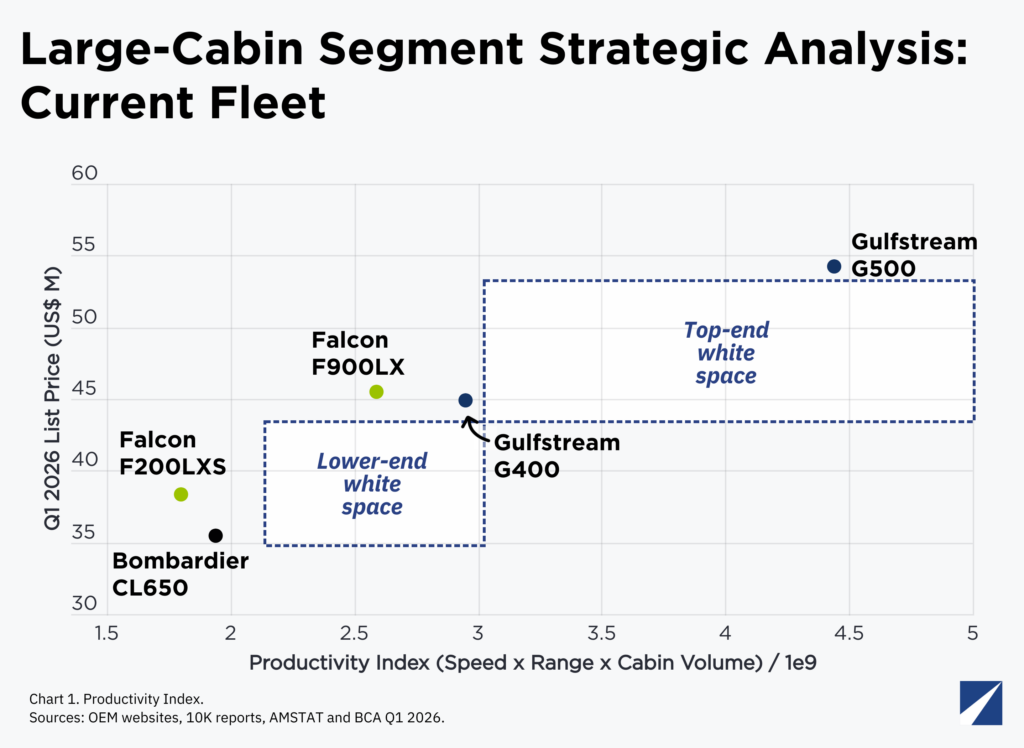
Strategically, Chart 1 says as much about pricing discipline as about capability. The G500 commands a clear premium justified by its PI lead, but the more telling signal is the G400: still uncertified yet priced to converge with the F900LX within $0.55M while promising a 14% PI advantage once it enters service.
That positions the F900LX awkwardly: no longer cheaper than a soon-to-be-certified Gulfstream competitor with a stronger index score, at the same time its own production is winding down. The Challenger 650 anchors the value end of the chart, and Chart 1 is the clearest visual evidence for why its buyer and operator economics hold up despite the lowest PI in the set.
Furthermore, Chart 2 presents a second analysis: a composite competitiveness score. Each aircraft’s PI, range, cabin volume, and speed is first min-max normalized (rescaled to a common 0-to-1 basis using the highest and lowest value for that metric across all five models) so that raw units (knots, nautical miles, cubic feet) don’t distort the comparison.
The four normalized scores are then combined as a weighted blend: 40% PI, 25% range, 20% cabin volume, and 15% speed. That weighting was chosen deliberately, favoring capability (PI and range together account for nearly almost two-thirds of the score) while still crediting cabin comfort and cruise speed rather than ignoring them.
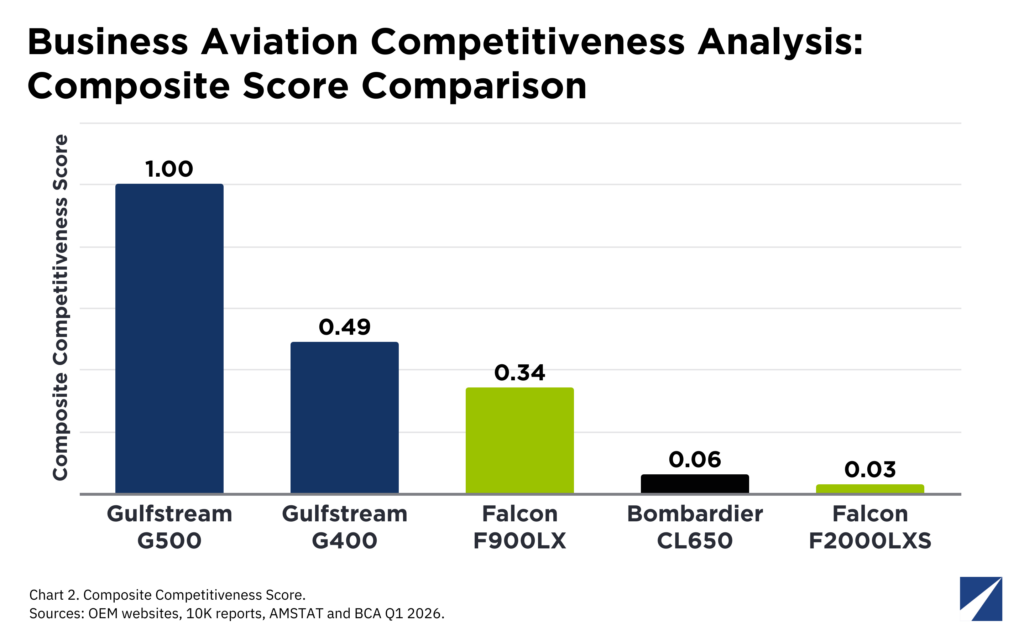
Chart 2 sharpens that read: on a weighted composite basis the G500 leads by a wide margin, the not-yet-certified G400 already sits a distant but clear second, and the F900LX,despite its tri-jet range advantage, trails both Gulfstreams before the Challenger 650 and F2000LXS bring up the rear. The strategic takeaway is that the F900LX’s competitive position was already softening on a pure-capability basis before its production status is even considered.
Those same scores, however, are also a starting point for a different question: not who wins on paper, but what each manufacturer can realistically do about its position. Neither Dassault nor Bombardier can out-invest this segment’s current returns therefore the strategic choice is narrower than that.
Three Paths, Diverging Positions
The three paths available to each OEM remain: clean-sheet design, a derivative program, or a staged refresh. Neither manufacturer has the balance-sheet appetite or the market urgency for a clean sheet in this segment right now, but Dassault’s option set is richer than Bombardier’s specifically because the Falcon 6X platform already exists: a derivative built off it is the more credible mid-capex path. Bombardier’s lack of an equivalent modern donor platform leaves it more dependent on refresh economics instead.
Price-versus-PI data now show two distinct clusters rather than one crowded band: the Challenger 650 ($35.5M) and the F2000LXS ($38.3M) sit within $3M of each other at the bottom, while the G400 ($44.95M) and F900LX ($45.5M) have converged to within $0.55M of one another higher up. That convergence is the more important finding: once certified, the G400 will barely undercut the production-wind-down F900LX on price by 1.2% while beating it by 14% on PI.
Furthermore, as shown in Charts 1 and 2, the Challenger 650 faces competitive pressure, but retains key advantages: lowest acquisition cost and strong charter and fractional market presence. Strategically, Bombardier could prioritize value enhancement over performance leadership. However, one of its most visible weaknesses is speed in addition to range.
Assuming a 6% improvement in speed and range through aerodynamic and engine tuning, an upgraded Challenger 650 product nee “the Challenger 680” could boost PI by approximately 12%, reaching 2.18 as illustrated in Chart 3.
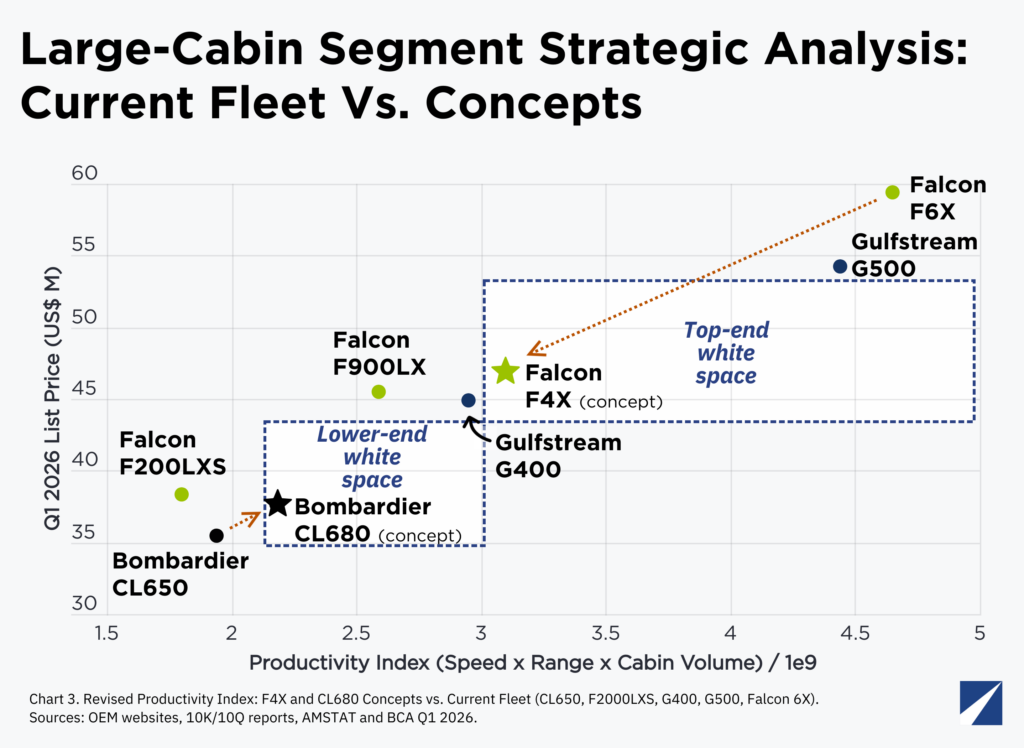
Strategically, Chart 3 illustrates upside Bombardier can capture cheaply: a 6% aerodynamic and engine-tuning improvement lifts the Challenger 650 from second-to-last in the field (ahead of only the F2000LXS) to a PI of 2.18, 22% above the F2000LXS and within roughly 19% of the F900LX, for an assumed price increase of only 6%, landing at a price of $37.6M essentially $700K below the F2000LXS price itself. Read alongside Charts 1 and 2, this is the more credible near-term refresh story in this segment: Bombardier has an active line, a stronger balance-sheet position on this asset and a clear, low-capex path to close a competitive gap.
Furthermore, a short-body, engine-derated Falcon 6X, nee F4X, changes that calculus further. Modeled at 76% to 79% of the full-size Falcon 6X’s $59.4M price (a band of roughly $45.1M to $46.9M), the F4X would enter the G400/F900LX cluster directly rather than undercutting it and would outscore every aircraft in the segment except the full-size 6X and G500 on capability.
Keeping the 6X’s 8’6” x 6’6” cross-section while removing roughly a fifth of its cabin length puts volume at approximately 1,475 to 1,550 cu ft (modeled at 1,500 cu ft), still ahead of the G400’s 1,441 cu ft; derating the PW812D engines to trade the 6X’s 5,500 nm for a targeted 4,500 to 4,700 nm deliberately kept below 5,000 nm so it challenges the G400 rather than the G500, where the full-size 6X already competes, and does so credibly (at a PI of 4.65, the full 6X now slightly leads even the G500’s 4.44), it is expected the F4X would cut enough structural, fuel-system, and certification cost to plausibly reach that price band (roughly $45.1M to $46.9M).
At the resulting specification (PI 3.10, Chart 3), the F4X would score approximately 5% higher PI than the G400, roughly 20% higher than the F900LX, and about 42% higher than the CL680 concept, all while pricing within the same $45M to $46.9M tier as the G400 and F900LX rather than below it resulting in the strongest capability-for-price position in the segment short of the full-size 6X itself.
Finally, is an “F900LX NextGen” refresh still realistic? The evidence increasingly says no. A refresh program presumes an active production line to refresh, and records and market evidence above suggests Dassault has already wound that line down, with the last new-build airframe dating to mid-2025 and 2026 positioned as a final-delivery year rather than a platform relaunch.
The more probable near-term outcome is that Dassault lets the F900LX exit gracefully, supporting the in-service fleet for parts and maintenance as it has for older Falcons for decades, while directing large-cabin tri-jet customers toward the full-size 6X for the time being, rather than investing in a refresh of a platform it has already begun retiring. That calculus could shift if a derivative F4X decision gets made, but absent one, a graceful exit is the default path.
Conclusion
Two manufacturer-specific recommendations follow, building directly on the analysis above. Dassault’s realistic near-term options for the F900LX are narrower than a refresh: the more credible path is a managed wind-down that protects existing owners’ collateral and residual value through explicit long-term parts and support commitments, while positioning the Falcon 6X and, eventually, the 10X as the successor products for large-cabin tri-jet customers, rather than investing in an “F900LX NextGen” program the evidence above suggests is unlikely to materialize.
The F4X belongs in this conclusion as more than a footnote to that wind-down, because it is the one option in this analysis that is not defensive. Built as a derivative of an already certified, already-in-production platform, it would price within the same $45M to $46.9M tier now occupied jointly by the G400 and F900LX, while outscoring both on the composite PI translating into a lower-capex program with a genuinely disruptive value proposition rather than a rescue for a declining one.
That production data also answers a fair objection raised elsewhere: if Dassault’s engineering bandwidth is tied up in the 10X regardless, why not simply keep the F900LX line idling until the F4X is ready? The twelve-month production gap suggests that ship has sailed. An idling line, by definition, still turns out occasional airframes to keep tooling, suppliers, and certification current which is roughly what the F900LX line did through mid-2025.
A full year of zero output is a different thing: it is closer to a shutdown than a pause and restarting a genuinely dark line carries a real re-commissioning cost that a merely slow one would not. If that reading holds, the F900LX’s fate was likely settled well before this analysis, not a live option Dassault is still weighing.
The timing constraint just got longer: Dassault’s engineering resources remain absorbed by the Falcon 10X program, whose entry into service slipped a second time in July 2026 (from late 2027 to not before 2029) as tighter post-737 MAX certification standards bear on an all-new clean-sheet design in ways they didn’t on the derivative-based F6X. That pushes the F4X’s plausible arrival further out as well; it is better understood as what could eventually replace the F900LX’s market position, on a timeline that has now moved further away rather than closer in, than as anything that helps the F900LX today.
That sequencing gap has an upside worth naming, and a risk worth naming alongside it and the risk is now larger than it looked before the July delay. The upside: it still lets Dassault exit the F900LX cleanly, without the pressure of rushing a successor, while holding a credible longer-term answer to a G400 that would otherwise have this price tier largely to itself.
The risk: every additional quarter of 10X-driven delay is a quarter the G400 spends uncontested in exactly the price band Dassault would need the potential F4X to defend, and the second 10X slip just added roughly two more years to that runway so the opportunity is real, but it now depends on Dassault greenlighting a program further out, and holding its nerve on the G400 for longer, than this article could say with confidence a few months ago.
Bombardier, by contrast, is in a stronger position to consider a modest CL680-style refresh from a position of strength rather than urgency, given its current pricing and liquidity advantage; sequencing that refresh too aggressively risks triggering the same residual-value compression for existing Challenger 650 owners that this analysis flags for the Falcon 900LX, so pacing (not direction) is Bombardier’s key strategic variable. Nevertheless, Bombardier’s stronger transactional and collateral metrics suggest the current Challenger 650 is not yet a distressed asset, and there is no need to rush a refresh at the expense of pricing discipline.

René Armas Maes is a Strategic Advisor at Forecast International, where he leads the Airborne Retrofit & Modernization Forecast portfolio across commercial aviation, business aviation, helicopters, and military platforms.
He brings 20 years of international experience driving revenue growth, commercial strategy, and margin improvement across airlines, business aviation, charter operations, OEMs, and aviation services.
A published author with more than 175 articles and market analyses in AvBuyer, FlightGlobal, AeroTime, Forecast International, and REDD Intelligence, René writes on commercial strategy, aviation economics, fleet planning, business restructuring, market intelligence, and capital allocation, and maintains an active business aviation blog.
Throughout his career, he has held senior commercial leadership positions at Airbus, Textron Aviation, and IATA. Earlier, as a consultant with ICF Aviation/SH&E in New York, he advised airline and business aviation clients on strategy and restructuring initiatives including Kuwait Airways, Saudia Airlines, Flynas and RoyalJet Group in Abu Dhabi, UAE – a leading VVIP business aviation operator in the Middle East.