Overview
Although the delivery of new aircraft fresh off the assembly line often steals the headlines, the global market for airborne retrofit and modernization is valued at tens of billions of U.S. dollars. With over 30,000 operational commercial aircraft currently crossing the skies and equally vast quantities of military assets filling out the force structures of states around the globe, aviation operators possess enormous requirements for the retrofit and sustainment of their existing fleets. For industry stakeholders, being able to understand and anticipate the demand dynamics and opportunities associated with civil and military modernization activity is critical to long-term success, as even a single airframe represents a reliable source of demand for parts and after-market services over its multi-decade service life.
Forecasting the airborne retrofit and modernization market has always been uniquely challenging due to the sparse guidance provided by MROs and operators regarding future program demand. To bring clarity and predictability to this opaque sector, Forecast International offers clients a data-driven market forecast that incorporates both quantitative modeling and the nuanced insights of our experienced subject matter experts.
Under the Surface: A Forecasting Model for the R&M Market
From human interface and communications upgrades to seating and Wi-Fi connectivity replacements, Forecast International’s Airborne Retrofit and Modernization Forecast is built to encompass and model the full range of ongoing segmental activities across the breadth of the retrofit market. The forecast is structured to provide clients both with a snapshot of the number of airframes of a given fleet anticipated to receive the relevant upgrade over the 10-year forecast period, as well as the anticipated U.S. dollar value of the segment.
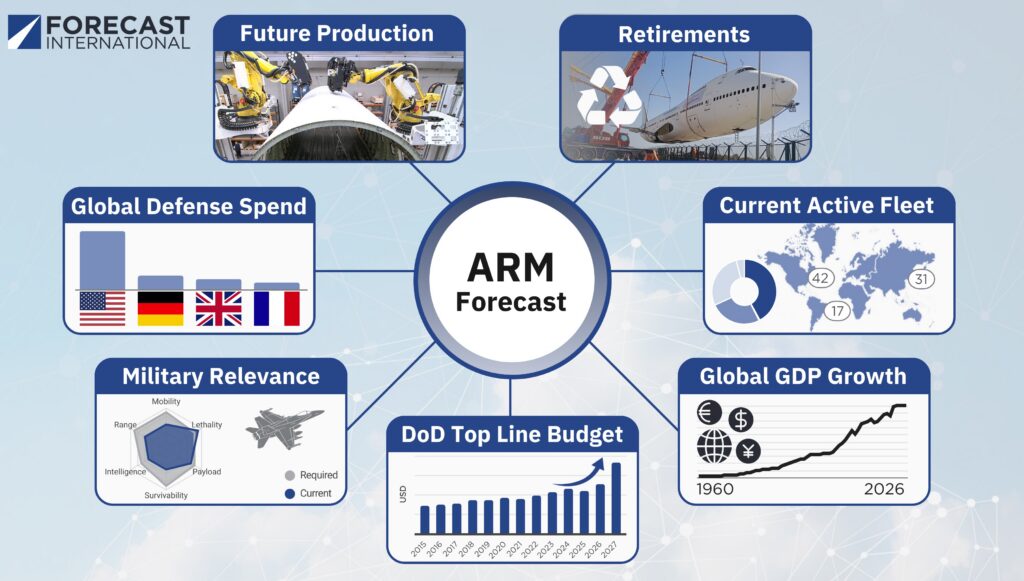
Our forecasting model is built to take into account the full range of economic and market indicators that not only exert influence both on the retrofit and modernization sector as a whole, but also those that drive the unique characteristics and dynamics of individual market sub-segments. The foundational basis of every retrofit and modernization forecast is the current size, age, and status of the operational global fleet of the relevant platform. With data provided by Forecast International’s real-time global aviation inventories tracking system and our own production and retirement forecasts, the growth or decline of the global operational fleet for each program is applied to a base conversion rate, which we determine for each opportunity on a particular program, and is based on the historical precedence of the total percentage of the entire fleet that typically goes through that specific modification in a given year. We then adjust this output for relevant macroeconomic factors such as global real GDP growth, global defense spending growth, and the military relevance of the program as a weighted composite driver index that is then applied to the conversion rates and total active fleet size of the program being forecasted.
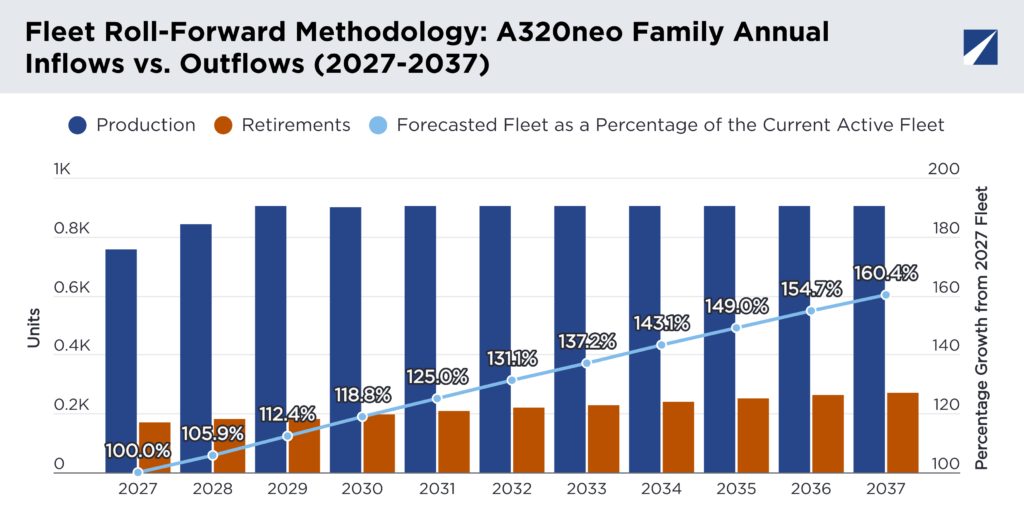
In order to generate forecasts at the level of individual segments, two complementary methodologies are employed to generate a single comprehensive 10-year snapshot. The forecast numbers are comprised of two data sources: Planned/In Progress opportunities and a base forecast that is determined by our model. Derived from formal government and industry announcements alongside credible media reports, our Planned / In Progress data covers active and scheduled retrofit programs bounded by explicit execution timelines, providing clients with an anchor of clarity in an otherwise opaque market. Yet because available public reporting rarely extends beyond a two-to-three-year horizon, relying solely on confirmed projects would understate true market activity. To resolve this, we synthesize the public procurement data with our proprietary baseline forecast. Under this methodology, each year’s baseline projection is evaluated against the aggregate Planned / In Progress total: whenever our baseline estimate is higher, it replaces the public total to account for unannounced modernizations and historical demand patterns, whereas in the infrequent cases where confirmed projects exceed the baseline, the higher Planned / In Progress volume takes precedence.
If you are interested in learning more about how Forecast International’s Airborne Retrofit and Modernization Forecast can be leveraged to support your organization’s objectives, reach out to our sales team or visit our website.