Which Falcon 2000EX retrofit product captures the demand (and the margin) as CRT obsolescence forces the fleet’s hand. René Armas Maes sizes a narrow retrofit niche and the equally narrow conditions under which the upgrade pays at all.
This article evaluates three avionics retrofit paths for a Part 135 charter operator of an early Collins Pro Line 4-equipped Falcon 2000EX, flying 500 hours per year. For context, the Falcon 2000EX was announced in October 2000, first flew in October 2001, and received FAA and JAA certification in March 2003, with deliveries beginning in May 2003. The initial 18 2000EXs were fitted with the Collins Aerospace Pro Line 4 avionics suite, while later production moved to the Dassault-Honeywell EASy flight deck (the Falcon 2000EX EASy). Falcon 2000 series production run through 2024 included 156 Falcon 2000EXs. That split matters more than any spreadsheet: this retrofit question applies to those 18 airframes alone.
In today’s market, pre-owned 2000EX values run from roughly $6.5M for earlier aircraft to about $12M for later EASy examples; the earliest Pro Line 4 airframes sit at the lower end, which is precisely where a modernization decision is most live. This analysis models a representative $6.5M Pro Line 4 aircraft and asks which of three glass paths an operator should pursue, why, and when the answer flips to “none of them.”
The Upgrade Landscape: Three Glass Paths
Three modernization routes are realistically available, and they bracket the decision by price and capability. The first, Universal InSight (Retrofit 1), replaces the legacy displays with a full glass suite and dual satellite-based-augmentation flight management systems. Universal Avionics and Trimec Aviation integrated the Universal InSight flight deck on a Falcon 2000EX, and in January 2024 the FAA extended the suite’s Supplemental Type Certificate; the suite supports UniLink communications, SBAS flight management systems and ANS 1A+, and ATN B1 capability. The second, the Collins Pro Line 21 (Retrofit 2) offers airspace-modernization upgrade, is the original-equipment-grade full glass deck. Collins Aerospace offers a Falcon 2000/2000EX retrofit to upgrade an existing Pro Line 4 installation to Pro Line 21, including four large liquid-crystal displays and an FMS with WAAS/LPV, ADS-B Out, improved situational awareness such as SVS and electronic charts, and turnkey compliance with FANS 1/A, ADS-B and SBAS.
The third, the Thomas Global TFD-4100 (Retrofit 3), is the targeted obsolescence fix. In September 2024 the Thomas Global TFD-4100 LCD Flight Display Upgrade for Pro Line 4-equipped Falcon 2000EX series aircraft received FAA STC approval, developed primarily to alleviate the deepening obsolescence associated with legacy EFD-4077 cathode-ray-tube display solutions. Transport Canada and UK CAA certification followed in October 2025. Each path addresses the same cathode-ray-tube (CRT) obsolescence, but the TFD-4100 does so as a display-only swap retaining the Pro Line 4 architecture, whereas InSight and Pro Line 21 modernize the entire deck and add capability a charter operator can actually sell.
Four-Lens on the Decision
The charter-economics case is best read from four angles. From the charter owner-operator perspective, the modernization is most defensible: lower avionics maintenance from retiring the obsolete Pro Line 4 displays, improved dispatch reliability, and expanded airspace access map directly to charter economics, where an aircraft-on-ground event is a lost-revenue event.
From a prospective buyer’s perspective, the benefit is acquiring an aircraft already modernized and immediately revenue-ready. Because the resale premium a glass deck commands is typically smaller than the installed cost, the buyer captures the spread, and listings already advertise these retrofits as headline features, key evidence the buyer pool values them.
On the seller side, a glass modernization can be a genuine resale decider on an aging 2000EX, because an obsolete CRT panel can deter buyers and lengthen days on market. A seller whose aircraft is otherwise difficult to move may recover enough in price and time to sale to justify the work, though recovery remains below full cost.
And finally, the financier. From a lender or lessor’s point of view, the upgrade mitigates a real residual-value risk: obsolescence on an out-of-production type. By restoring mandate compliance and marketability, it supports collateral value and shortens remarketing time, a modest but real positive for loan-to-value.
Building the Case: Methodology and Assumptions
The analysis modeled a representative Pro Line 4 Falcon 2000EX valued at $6.5M over a five-year hold at an 8% discount rate and 500 charter hours per year. Retrofit installation costs were valued between $400K for the display-only TFD-4100 and $950K for the Collins Pro Line 21, with Universal InSight in between at about $750K, roughly 12% of hull value.
The annual benefit was built from four charter-relevant streams: avoided avionics maintenance from retiring the obsolete Pro Line 4 displays; dispatch-reliability protection from fewer aircraft on ground events (AOG) and cancelled trips; efficiency and access from CPDLC, LPV and oceanic capability; and a marketability premium for a FANS- and LPV-equipped aircraft. These figures should be validated against the specific aircraft’s squawk and AOG history rather than assumed from the type.
On the offset-costs side, the model deducts database subscription and recurrent training, and the exit benefit combines partial recovery of the installation cost in resale price with a days on market saving. The residual assumptions that help the case are the ones most exposed to obsolescence, so they were treated conservatively. The alternative decks were modeled on the same basis.
The Verdict: Choosing Among the Three Retrofit Paths
Placed on a common financial footing, Universal InSight (Retrofit 1) is the best-value choice. It returns the only positive NPV of the three at the operator’s hurdle, roughly +$20K (Chart 1), an internal rate of return near 8.7%, and an undiscounted benefit-to-cost ratio of about 1.4x, with discounted payback achieved within the five-year hold, because it delivers most of the original-equipment Pro Line 21 deck at a price much closer to a modest display swap.
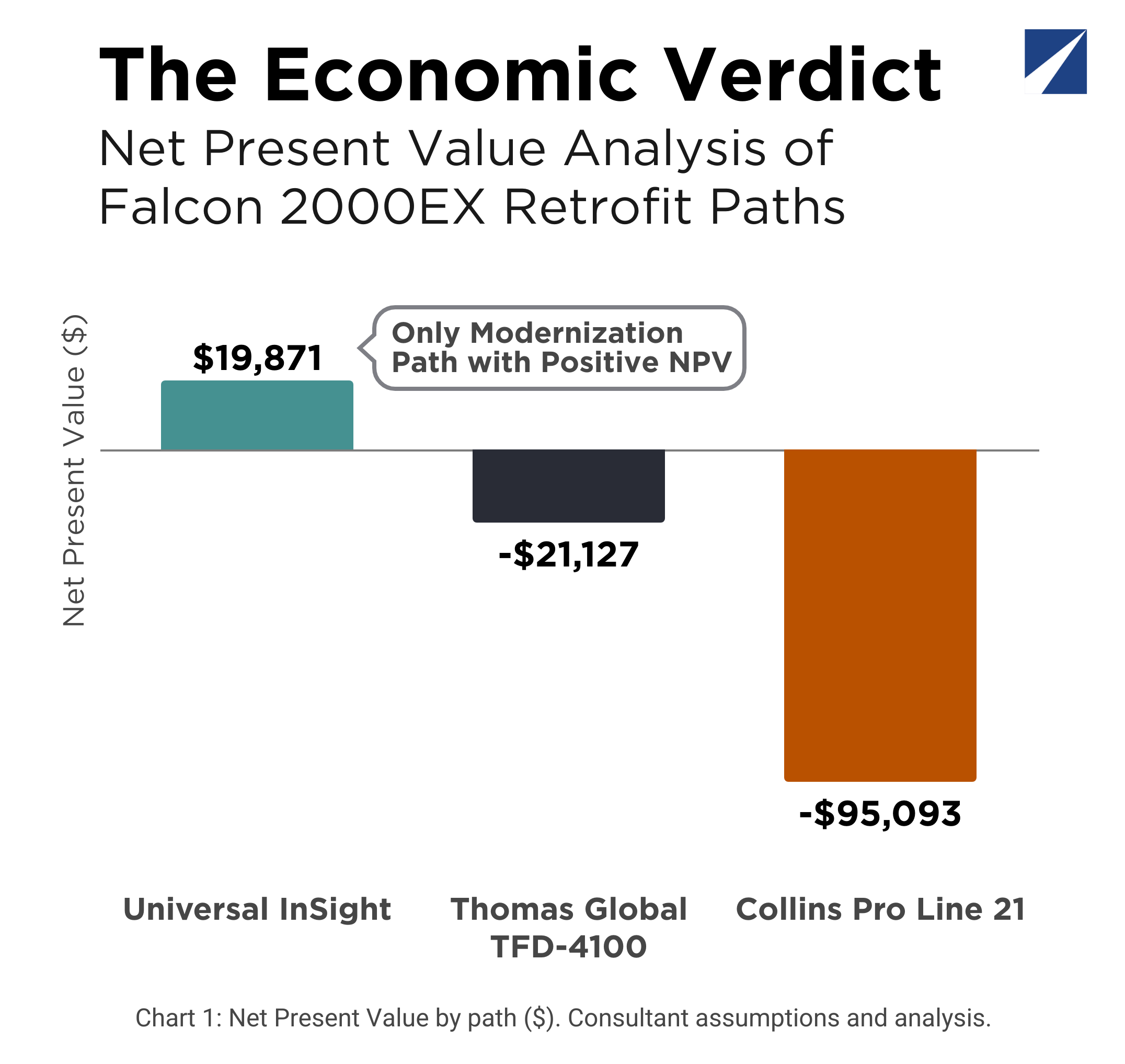
The Collins Pro Line 21 (Retrofit 2), despite comparable functionality and a strong original-equipment pedigree, is dragged to a NPV of −$95K by its assumed higher acquisition cost; its premium is difficult to recover on an aircraft of this value. The Thomas Global TFD-4100 (Retrofit 3) is cheapest, but it is a display-only patch: it resolves the CRT obsolescence yet adds no LPV, FANS/CPDLC or synthetic vision and does little for marketability. At a NPV of −$21K it does not clear the hurdle.
The practical implication is that capability per dollar, not maximum capability or minimum cost, is the right selection criterion for a value-driven charter operator.
When It Makes Sense, and When It Does Not
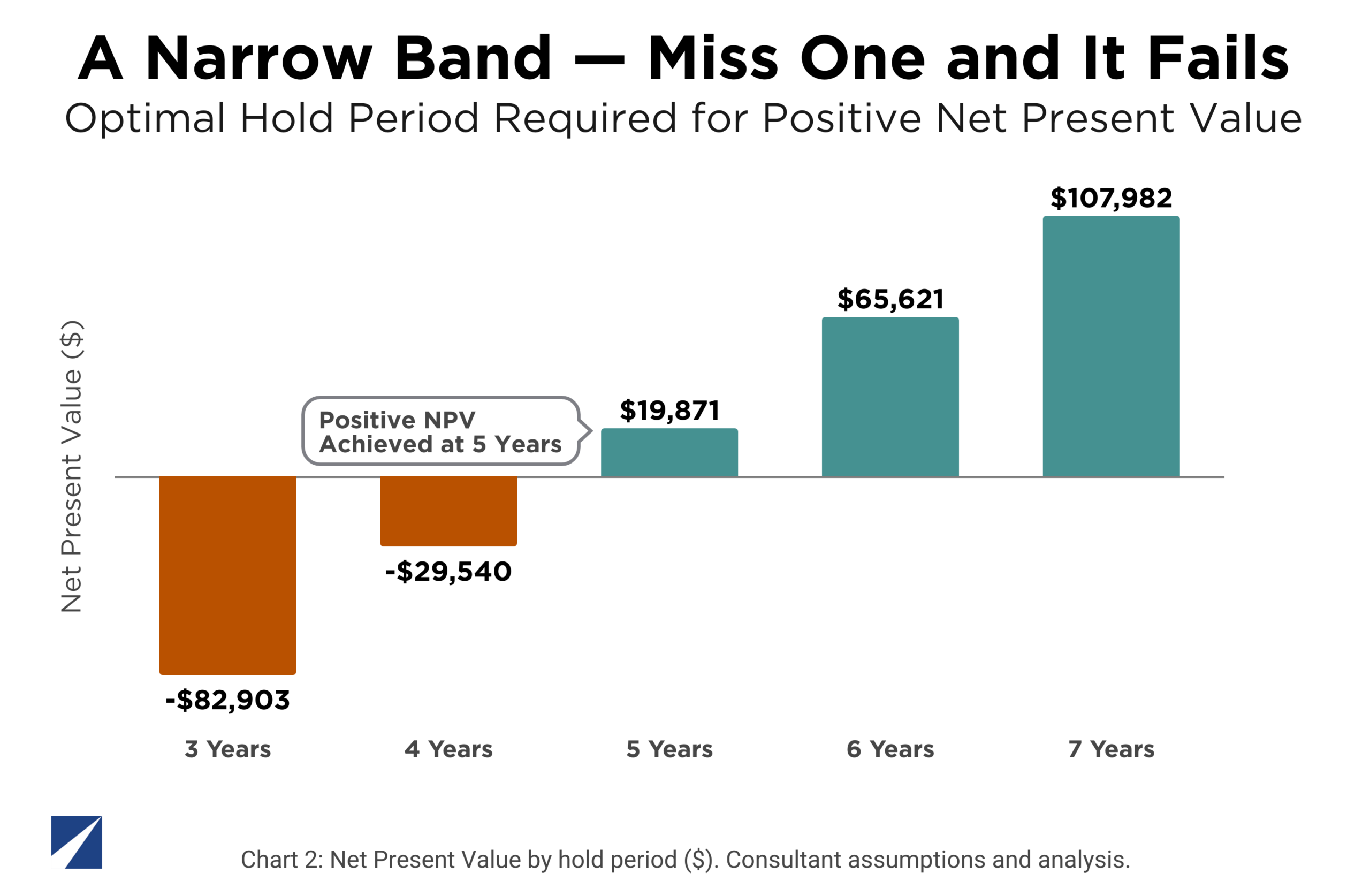
Naming a winner is the easy half. The harder question is under what circumstances the winner still wins, and the break-even analysis shows a narrow band. First, hold period: the InSight case is negative at a three-year hold (−$83K) and still negative at four (−$30K), turning positive only at five. An operator planning to exit sooner should not modernize as shown in Chart 2.
Second, installation price: the case breaks even near $780K against a $750K assumption, roughly 4% of headroom. Third, the benefit stream breaks even near $112K per year against $117K assumed, a margin under $5K.
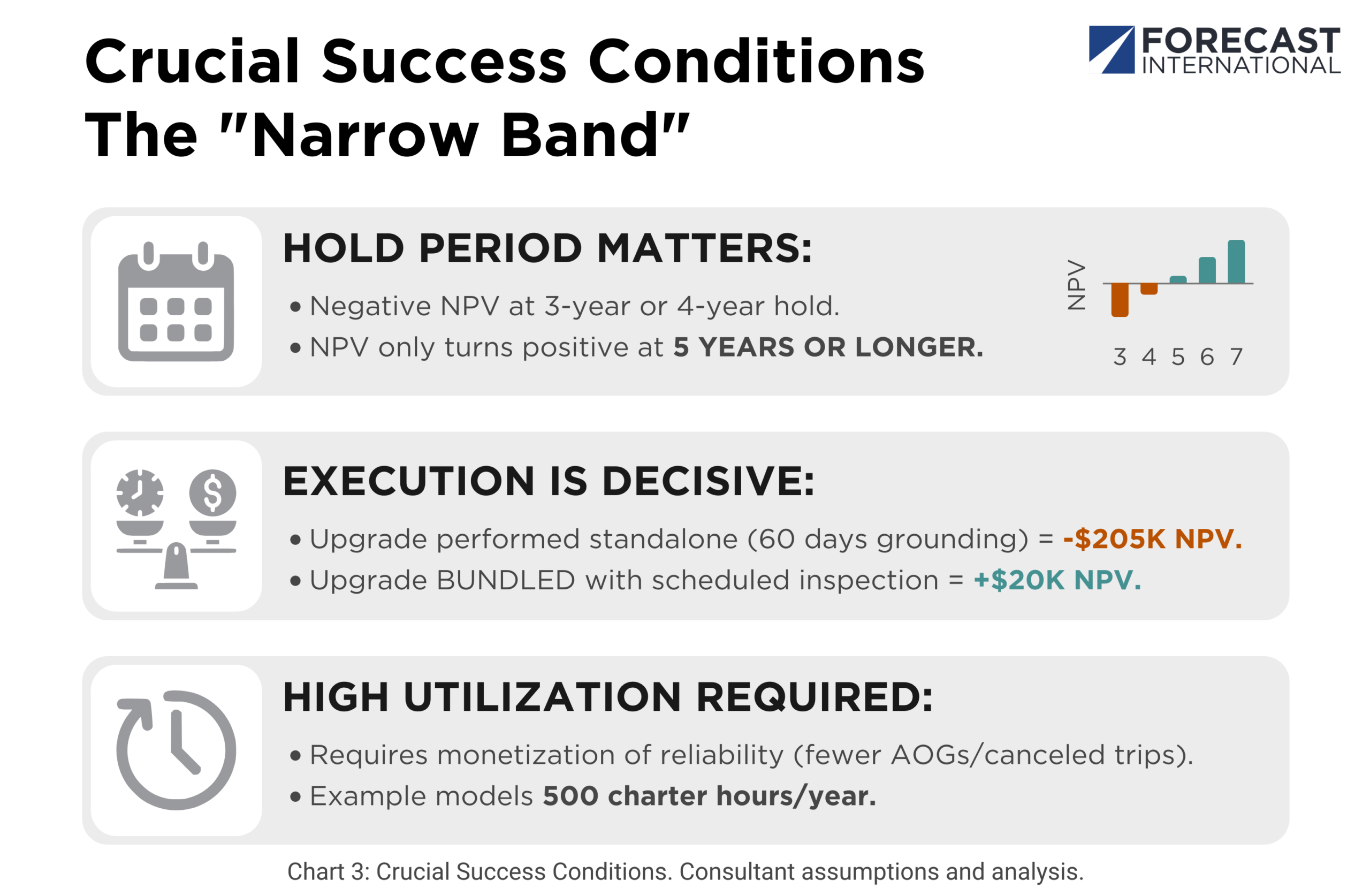
The decisive variable is execution. Bundled into a scheduled inspection the case returns +$20K; performed standalone, grounding a revenue aircraft for some 60 days, the same upgrade returns −$205K. Nothing else moves the outcome that far. So the upgrade makes sense for an operator holding at least five years, flying hard enough to monetize dispatch reliability, able to bundle the work into planned downtime, and able to evidence the savings from its own records as illustrated in Chart 3.
Outside that band, run the aircraft out, patch only if the panel becomes unsupportable, or divest. The TFD-4100 remains a defensible stopgap for a short remaining hold, but it is a patch, not a modernization. Where an operator runs more than one 2000EX, standardizing the fleet compounds the benefit through reduced training and spares cost.
The Opportunity: Where the Money Is
Beyond a single aircraft, the segment must be sized honestly, and the number is sobering. The initial 18 2000EXs were fitted with the Collins Aerospace Pro Line 4 avionics suite, and that is the entire addressable pool for these three products. After two decades, not all will proceed. At 50% adoption, roughly eight to nine aircraft may modernize. At a representative $700K installation, the theoretical maximum is $12.6M. By path and assuming eight aircraft modernize, demand is worth about $3.2M at the TFD-4100’s price, $6.0M at InSight’s, and $7.6M at Pro Line 21’s.
For an investor or manufacturer, that arithmetic is the strategic finding. Capital should not chase the 2000EX Pro Line 4 slice on its own merits. It should back platforms whose engineering is already paid for, where this fleet is incremental, margin-accretive volume rather than a business case in itself. The prize is real but small, and it scales with how much capability operators buy per airframe.
Conclusion
For a Part 135 charter operator of a Pro Line 4 Falcon 2000EX, Universal InSight is the value-leading modernization: at an 8% hurdle it is the only one of the three glass paths that pays for itself. Its justification rests not on novelty but on cost avoidance and on the revenue protection a modern, FANS- and LPV-equipped deck provides.
But the margin is thin and the conditions strict: a five-year hold, a bundled installation, a disciplined quote, and savings the operator can evidence. Miss one and the case fails. Across the fleet this is a niche of roughly eight to nine likely aircraft, not a market to build a business around, which is why the winning products are those that arrive already paid for.

René Armas Maes is a Strategic Advisor at Forecast International, where he leads the Airborne Retrofit & Modernization Forecast portfolio across commercial aviation, business aviation, helicopters, and military platforms.
He brings 20 years of international experience driving revenue growth, commercial strategy, and margin improvement across airlines, business aviation, charter operations, OEMs, and aviation services.
A published author with more than 175 articles and market analyses in AvBuyer, FlightGlobal, AeroTime, Forecast International, and REDD Intelligence, René writes on commercial strategy, aviation economics, fleet planning, business restructuring, market intelligence, and capital allocation, and maintains an active business aviation blog.
Throughout his career, he has held senior commercial leadership positions at Airbus, Textron Aviation, and IATA. Earlier, as a consultant with ICF Aviation/SH&E in New York, he advised airline and business aviation clients on strategy and restructuring initiatives including Kuwait Airways, Saudia Airlines, Flynas and RoyalJet Group in Abu Dhabi, UAE – a leading VVIP business aviation operator in the Middle East.