
Halfway through 2026, Bombardier and Gulfstream are both sitting on order books that are growing faster than either can build airplanes, but the shape of that growth looks different at each company. Bombardier’s expansion is pulled almost entirely by fleet operators. On the other hand, Gulfstream is compounding a scale advantage as its newest widebodies hit their delivery stride. Table 1 shows both OEMs’ 2023-2026 production, backlog, order data and lays out where the two OEMs sit heading into the back half of the year.
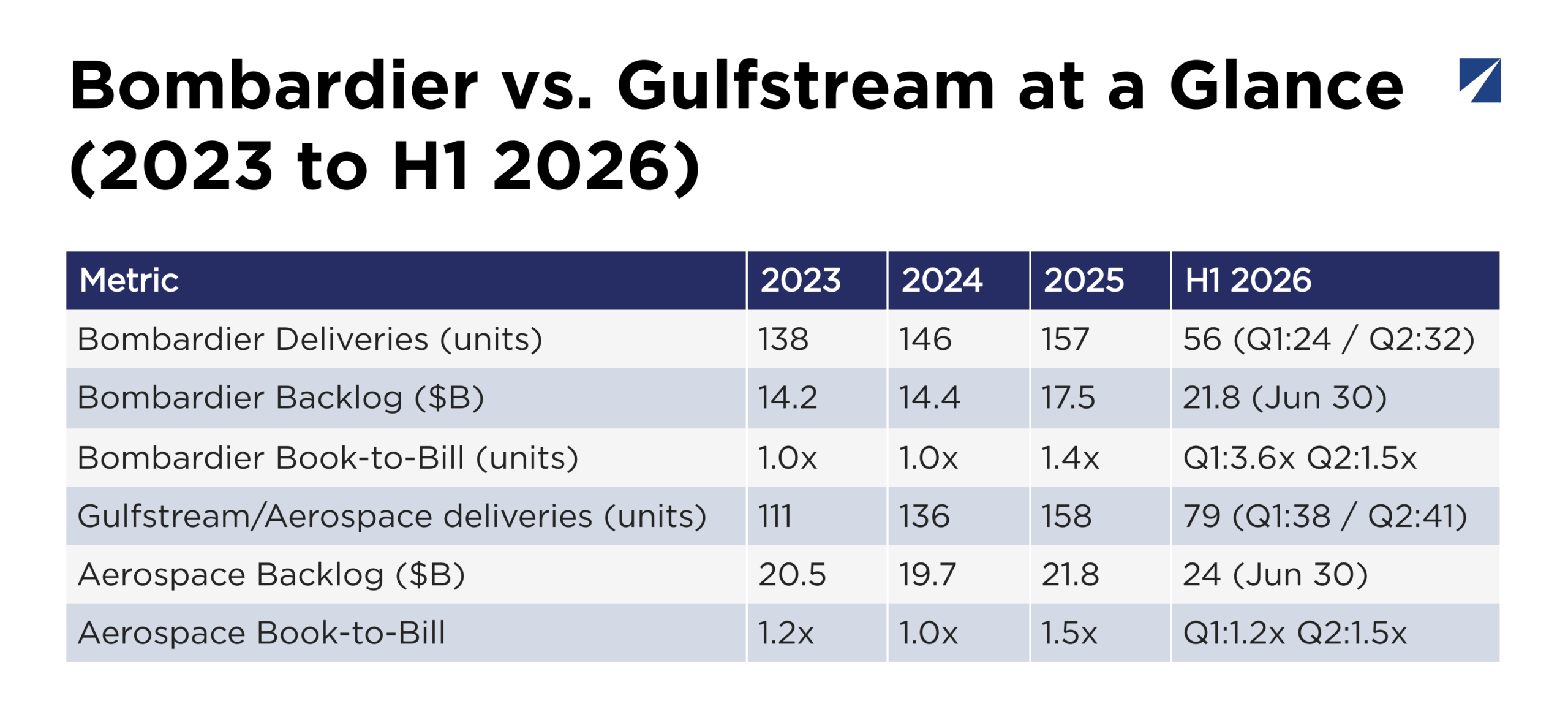
Table 1. Bombardier vs. Gulfstream at a glance (2023 to H1 2026). Source: Aviation Flights Database, Gama.aero, Bombardier and General Dynamics Corp. earnings releases, MD&A and 10-K/10-Q filings, 2023 to 2026.
Production: Climbing, But on Different Curves
Bombardier delivered 138 aircraft in 2023, 146 in 2024 and 157 in 2025, three straight years of growth. The pace held into 2026: 24 units in Q1 (versus 23 a year earlier) and 32 in Q2, down from 36 a year ago, a dip the company attributed to an isolated supplier disruption rather than softer demand, for a total of 56 aircraft through the first half. Full-year guidance remains “more than 157” units, with management flagging a heavy Q4 skew, consistent with the pattern of the last three years, in which Q4 has averaged 40% of full-year deliveries.
By contrast, Gulfstream’s curve has been steeper. General Dynamics’ Aerospace segment delivered 120 aircraft in 2022, then dipped to 111 in 2023 as G650 production wound down ahead of G700 certification, before climbing to 136 in 2024 and 158 in 2025 as the G700 ramped and the G800 entered service. The first half of 2026 kept that trajectory intact: 38 deliveries in Q1 and 41 in Q2 (three more than a year earlier), keeping Gulfstream on pace for its raised full-year target of roughly 160 units (see Chart 1).
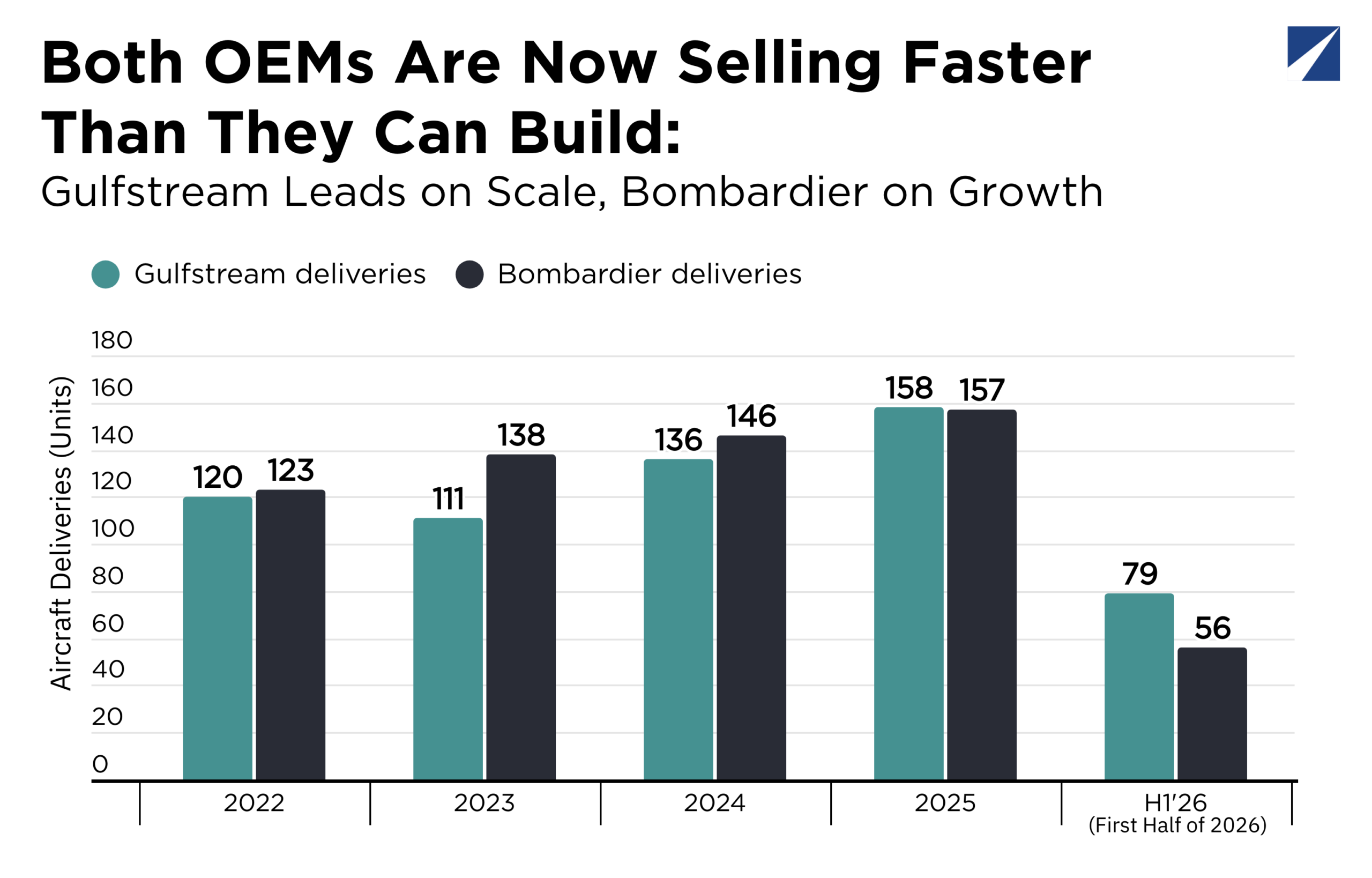
Chart 1. Aircraft Deliveries, Bombardier vs. Gulfstream (2022 to H1 2026). Source: Bombardier and General Dynamics Corp. quarterly/annual earnings releases, 2022 to 2026.
Unlike Bombardier, Gulfstream’s growth is now almost entirely a large-cabin story: 35 of the 41 Q2 deliveries – 85% – were large-cabin jets, against just six mid-cabin (G280) units.
Backlog and Book-to-Bill: Both OEMs Are Now Demand-Constrained
Bombardier’s backlog troughed at $14.2 billion at year-end 2023 (book-to-bill 1.0x), edged up to $14.4 billion in 2024 (also roughly 1.0x), then jumped to $17.5 billion at year-end 2025 as unit book-to-bill reached 1.4x. Moreover, 2026 has been extraordinary: backlog reached $20.3 billion at the end of Q1 and a book-to-bill ratio of 3.6x (net new aircraft orders, in units, net of cancellations, for the quarter divided by aircraft delivered, in units, for the quarter) as illustrated in Chart 2.
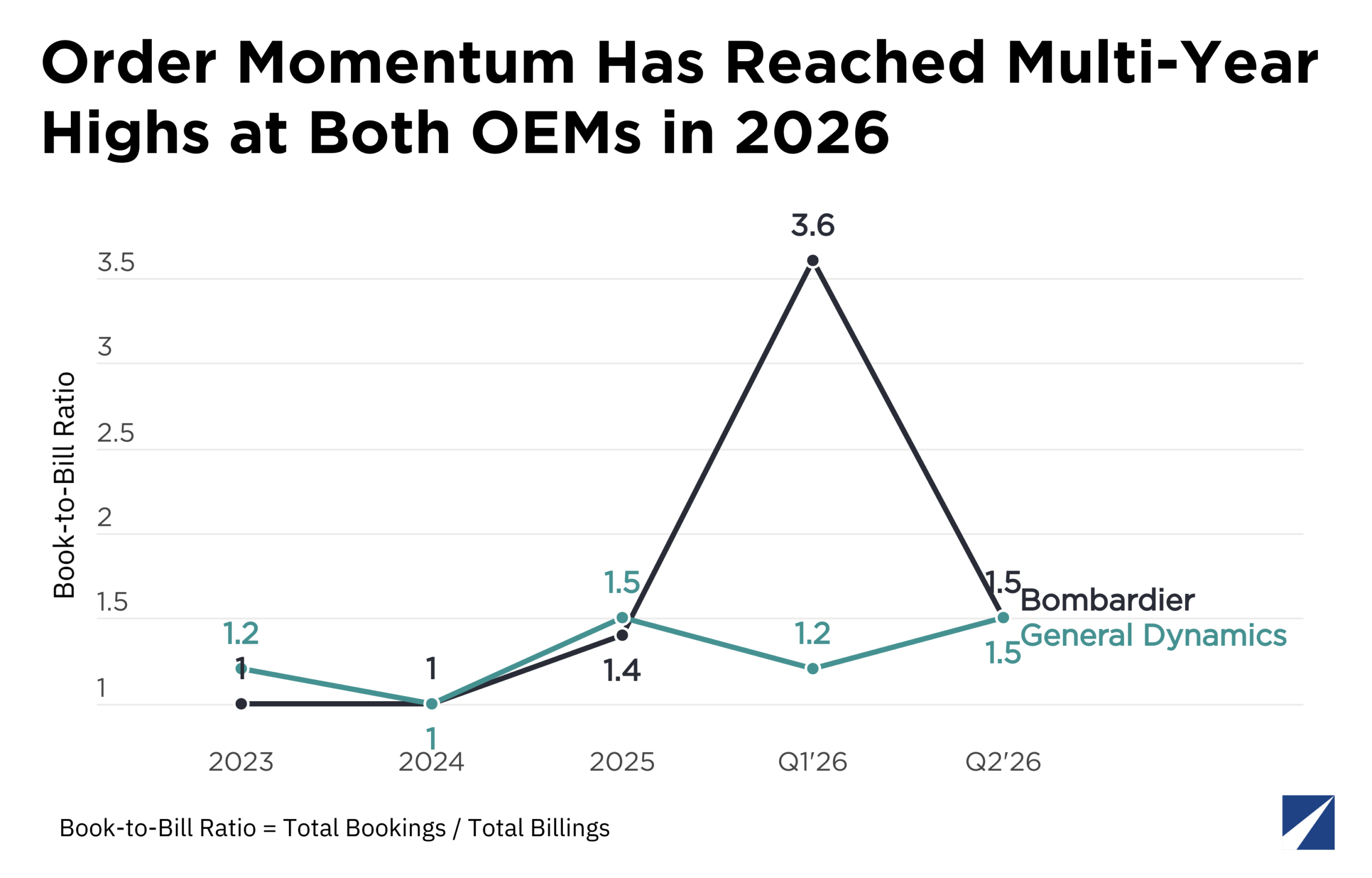
Chart 2. Book-to-Bill Ratio, Bombardier and General Dynamics Aerospace (2023 to H1 2026). Source: Bombardier Inc. and General Dynamics Corp. quarterly/annual earnings releases, 2023 to 2026.
For Q1 2026, Bombardier delivered 24 aircraft. A 3.6x ratio implies net new unit orders of roughly 24 × 3.6 = 86 to 87 aircraft booked (net of cancellations) during the quarter. This was followed by a backlog of $21.8 billion at the end of Q2 and a book-to-bill of 1.5x. That is a $4.3 billion increase in six months – roughly 25% backlog growth in half a year.
Gulfstream’s Aerospace segment backlog has followed a similar but less dramatic arc: $19.5 billion at year-end 2022 (book-to-bill 1.5x), $20.5 billion in 2023 (1.2x), $19.7 billion in 2024 (about 1.0x, as record deliveries absorbed orders), then $21.8 billion at year-end 2025 (book-to-bill roughly 1.5x for the year). The first half of 2026 has been Gulfstream’s best ordering stretch since 2022: backlog reached $22.3 billion at the end of Q1 (book-to-bill 1.2x) and $24.0 billion at the end of Q2 (book-to-bill 1.5x for the quarter), management’s strongest characterization of order intake in four years.
Read together, both companies are now selling faster than they can build translating into a genuinely different environment from 2023-2024, when Bombardier’s book-to-bill hovered near a flat 1.0x and Gulfstream’s dipped to 1.0x in 2024 on record deliveries. The risk this creates is less about demand and more about execution: extending lead times, inventory build and the consequential working-capital drag that comes with it.
Segment Read: Where Each OEM Actually Competes
Neither manufacturer plays in the light (up to 2,200nm) or midsize (2,201-3,350nm) jet categories that Textron and Embraer dominate. Bombardier’s Challenger 3500 and Gulfstream’s G280 sit in the super-midsize jet category (3,351-4,049nm); Bombardier’s Challenger 650 sits in the large segment (4,050-5,300nm) alongside Gulfstream’s G400 and G500; Bombardier’s Global 5500/6000/6500 and Gulfstream’s G600 sit in the super-large jet category (5,301-6,600nm); and Bombardier’s Global 7500/8000 and Gulfstream’s G700/G800 own the ultra-long-haul category (6,601nm and up, with the Global 8000 and G800 both nominally rated near 8,000nm).
That concentration at the top of the market is precisely why both companies’ 2025-2026 growth has been fastest in their largest cabins: Gulfstream’s large-cabin lineup (G500/G600/G700/G800) accounted for 86% of its total 2025 deliveries and drove 82% of the company’s 2024-to-2025 delivery growth, with the G700 and G800 ramp doing most of the work within that group, while Bombardier’s Global 7500/8000 line and the Vista-driven Challenger 3500 order book are doing the same for Bombardier.
However, the one real structural gap opening up is in the super-midsize segment: Gulfstream’s G280 is winding down (final delivery expected Q2 2027) ahead of the G300’s 2027/2028 entry into service, creating a planned production break Gulfstream itself has flagged. That leaves Bombardier’s Challenger 3500 (freshly reinforced by Vista’s 40-unit order) as the only OEM with continuous super-midsize output through the transition, a real, if temporary, competitive opening.
Supply Chain and Production Risk
Supply chain remains the swing factor for both OEMs, though it is easing. Bombardier’s Q1 2026 shortfall (about five aircraft that should have been delivered in the quarter) was traced to a single supplier issue that management said has been resolved, with the affected units to be delivered later in the year. The company also flagged that because build cycles run 12-24 months, the benefit of improving supplier performance won’t fully show up in deliveries until Q4 2026, with a bigger effect in 2027. Bombardier’s Q2 2026 delivery total (32, down from 36 a year earlier) reflected the same lingering effect.
General Dynamics management characterized its supply chain as “stabilized” in the Q2 2026 call, crediting productivity gains and the ability to move down the learning curve on newer aircraft programs (G700, G800), which is showing up in margin: Aerospace segment operating margin reached 14.5% in Q2 2026, its strongest level in years. The one company-specific risk flagged by General Dynamics itself is the G280, built in Israel by Israel Aerospace Industries – management called out both geographic/geopolitical exposure and the upcoming production gap into the G300 as items to watch through 2027.
Fleet Orders: The New Demand Engine
The defining feature of 2026 order activity, at both OEMs, is fleet-operator concentration. On February 11, 2026, Vista placed a firm order for 40 Bombardier Challenger 3500s (worth $1.18 billion at list prices) with options for 120 more (total potential value $4.72 billion), on top of converting its Global 7500 backlog into the new Global 8000, Vista has communicated it intends to run the largest subscription-based Global 8000 fleet by year end.
Across the industry, fleet operators (NetJets, Flexjet, Vista and peers) have placed large orders representing a structural demand shift. As of Bombardier’s own 2024 disclosure, fleet operators already represented about 20% of its backlog; that share has almost certainly grown given the scale of the Vista order alone.
This concentration cuts both ways. It is a genuine tailwind for backlog visibility and pricing power at both OEMs (a large, credit-quality fleet buyer locking in years of production is about as good a demand signal as an airframer can get). But Bombardier (along with Embraer and Textron) carries meaningfully higher fleet-operator concentration than Gulfstream or Dassault, whose customer bases skew toward corporations and high-net-worth individuals.
Large, multi-unit fleet orders are almost always negotiated at a discount to list price, and Bombardier’s Q1 2026 adjusted EBITDA margin did fall about 90 basis points year-over-year even as revenue and backlog grew. That discount is plausibly offset, at least in part, by the aftermarket revenue fleet operators generate over an aircraft’s life: fleet jets fly more hours, driving more maintenance, parts and training work, which is consistent with Bombardier’s services revenue growing 25% year-over-year in Q1 2026 to $617 million and its new $300 million multi-year parts agreement with Vista signed in April 2026. The offset isn’t a clean hedge, though: both the discount and the aftermarket revenue meant to cushion it come from the same customer relationship, so a slowdown in fractional/charter flying would likely pressure both sides at once rather than one insulating the other.
That means Bombardier is somewhat more exposed than Gulfstream if fractional/charter demand growth ever reverses though NetJets’ scale and financial strength have historically limited the risk of aircraft flooding the secondary market. One case worth studying, however: NetJets phased its Cessna Citation X fleet out entirely between 2019 and 2020, and Vista separately offloaded its remaining Citation X units to a wholesale buyer. This is the clearest documented example of a major fleet operator’s exit from a type pressuring that aircraft’s residual values on the secondary market. It’s not a Bombardier or Gulfstream aircraft, so it isn’t a direct precedent, but it’s the best available real-world analogy for what a large-scale fleet wind-down could mean for values if fractional demand ever turned.
For now, with fractional flying up double digits year over year (ARGUS put North American fractional operations up 11.7% in H1 2026) and fleet operators still standardizing single-OEM fleets for maintenance and training efficiency, the trend favors continued order strength rather than a pullback.
Preowned Inventory: A Pricing Tailwind for New-Aircraft OEMs
AMSTAT’s Q2 2026 data (through June) shows preowned inventory still historically tight and getting tighter at the top of the market that matters most to Bombardier and Gulfstream. Heavy-jet inventory (the category closest to Global/G-series large-cabin aircraft), stood at just 5.2% of the active fleet in June 2026, below the 10-year average of 7.0% and its lowest level since February 2023, down 20.9% year over year. Super-midsize inventory was 6.6% of the fleet, just under its 10-year average and its lowest level since March 2024, down 1.2% year over year. Heavy-jet transactions surged 43.8% year over year in Q2 2026 (the strongest quarterly total in a decade) while median heavy-jet resale values rose 13% year over year and a further 5% within Q2 alone, even as average asking prices fell on a mix shift toward younger, lower-time inventory, as illustrated in Chart 3.
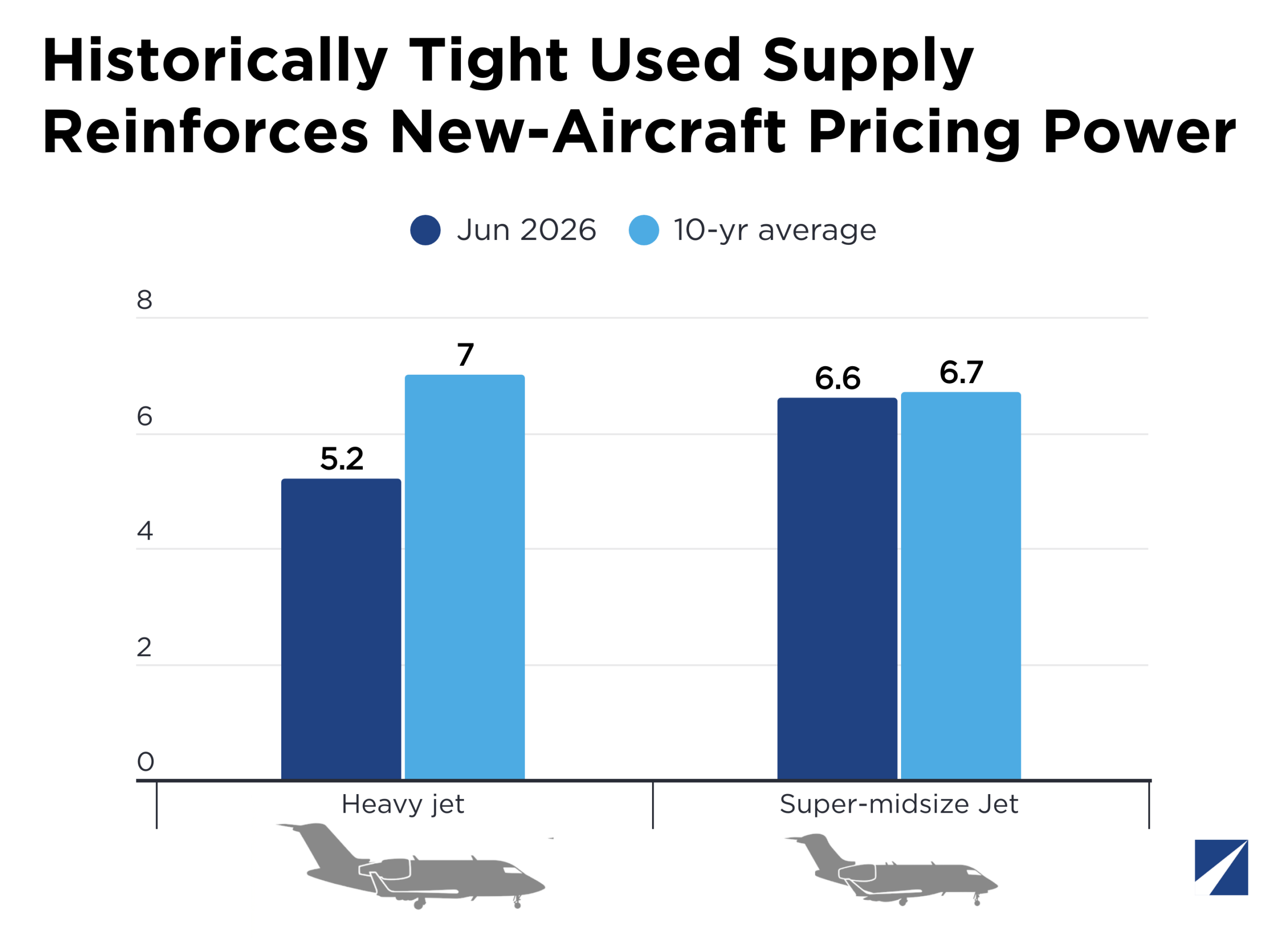
Chart 3. Preowned Inventory as % of Active Fleet Listed for Sale, June 2026. Source: AMSTAT Business Aircraft Preowned Market Update, Q2 2026.
For OEMs building new large-cabin and ultra-long-haul jets, that combination (tight preowned supply, rising median values on the newest used units, and buyers who cannot find a late-model secondary-market aircraft) pushes demand toward the factory order book rather than away from it, reinforcing the book-to-bill strength both companies are already reporting.
For example, Gulfstream’s stretching backlog is pushing large-cabin buyers who need an airplane sooner than a multi-year delivery slot toward used G650/G550 inventory, giving sellers of that specific inventory real pricing leverage. The read-through for Bombardier and Gulfstream is the same: as long as preowned large-cabin and super-midsize supply stays this tight, neither OEM needs to discount to protect volume, at least for retail sales.
Conclusion: Market Opportunities and Bottom Line
Four items stand out for the second half of 2026 and into 2027. First, the super-midsize gap: with Gulfstream’s G280 sunsetting (final delivery expected Q2 2027) and its replacement, the G300, not arriving before late 2027/2028, Bombardier’s Challenger 3500 has a multi-quarter window with effectively one fewer direct competitor, just as Vista’s 40-unit order proves out demand at scale in that exact bracket.
Second, a narrower (and now less certain) version of the same window exists one tier up. Gulfstream’s G400, a 4,200nm large-cabin aircraft is not a direct Challenger 3500 rival by range or cabin class; it’s positioned against the Challenger 650 and Dassault Falcon 2000LXS, the bracket just above super-midsize. But unlike the G300, whose entry into service General Dynamics has pointed to as late 2027, the G400 now carries no company-committed timeline at all: asked directly on the same call, CEO Novakovic said she is “no longer in the business of estimating EIS, given that the regulators set the pace,” promising only that Gulfstream will “have more to say over the next couple of quarters.”
That makes Bombardier’s opening at the 3500/super-midsize level real and comparatively clean through the G280-to-G300 gap, but the opening one tier up, at the Challenger 650/entry-large-cabin level, is harder to size but it could close as soon as Gulfstream commits to a G400 date or persist well past 2027 if certification keeps slipping. Nonetheless, Gulfstream is effectively racing to get new metal into the market, but for the G400 specifically, it hasn’t yet said when the race ends.
Third, ultra-long-haul remains the fastest-growing, highest-margin segment for both OEMs, the Global 7500/8000 and G700/G800 pairing is where both companies’ delivery and revenue growth is concentrated, and neither shows signs of slowing.
Fourth, the fleet-operator order wave, while a concentration risk in isolation, is currently the single biggest driver of backlog growth (at least at Bombardier) and shows no sign of reversing given fractional flight-hour growth.
Overall, both OEMs are better off than a year ago on every headline metric: deliveries, backlog and book-to-bill – with Gulfstream ahead on scale and margin, and Bombardier ahead on backlog growth rate and order momentum. The principal watch-items are execution, not demand: Bombardier’s supplier-driven delivery timing and Q4 skew, and Gulfstream’s G280-to-G300 production gap. Absent a broader macro shock, current trends point to both companies closing 2026 at or above guidance, with 2027 shaping up as the year supply-chain repair finally shows up in smoother quarterly delivery cadences.

René Armas Maes is a Strategic Advisor at Forecast International, where he leads the Airborne Retrofit & Modernization Forecast portfolio across commercial aviation, business aviation, helicopters, and military platforms.
He brings 20 years of international experience driving revenue growth, commercial strategy, and margin improvement across airlines, business aviation, charter operations, OEMs, and aviation services.
A published author with more than 175 articles and market analyses in AvBuyer, FlightGlobal, AeroTime, Forecast International, and REDD Intelligence, René writes on commercial strategy, aviation economics, fleet planning, business restructuring, market intelligence, and capital allocation, and maintains an active business aviation blog.
Throughout his career, he has held senior commercial leadership positions at Airbus, Textron Aviation, and IATA. Earlier, as a consultant with ICF Aviation/SH&E in New York, he advised airline and business aviation clients on strategy and restructuring initiatives including Kuwait Airways, Saudia Airlines, Flynas and RoyalJet Group in Abu Dhabi, UAE – a leading VVIP business aviation operator in the Middle East.