Airbus Production Ramps Up /// A350 Production Posts Strongest Month of the Year /// 737 MAX Production Falls Short of 38 Aircraft


Airbus A350 FAL – Image – Airbus
For the purposes of this article, Forecast International considers an aircraft to be “produced” once it completes its first test flight, and “delivered” when it is contractually handed over to the customer.
Overview
Airbus led the month in total production, completing 91 aircraft, followed by Boeing with 45, resulting in a combined total of 136 aircraft. Of these, 109 were narrowbody aircraft, while the remaining 27 were widebodies. On the delivery side, Forecast International expects Boeing to have delivered a total of 44 aircraft in November, including 32 737 MAXs one 737-800A, and the remaining 11 aircraft to be widebodies. For Airbus, we estimate total deliveries of 74 aircraft, comprising 67 narrowbodies and nine widebodies. 59 of the narrowbodies are expected to be A320neo family aircraft, and the remaining eight are expected to be of the A220 family.

Notes:
- Production data represents the actual number of aircraft produced in November 2025. Forecast International considers an aircraft produced upon its first flight. This may differ from an OEM’s definition of produced.
- A320neo numbers include all variants for the family; A319neo, A320neo and A321neo
A320neo family production remained strong in November, with Airbus completing 67 aircraft, marking one of the highest-output months of 2025 and extending the rebound seen in September and October, making it another month above the company’s 50-per-month target. Airbus also produced 10 A220s, continuing the program’s steady monthly rhythm, while widebody output included 6 A330neos and 8 A350s. Boeing’s November activity was again led by the 737 MAX program, with 32 aircraft completed, alongside 2 767s, 3 777s, and 8 787 Dreamliners, bringing the company’s total production for the month to 45 aircraft.
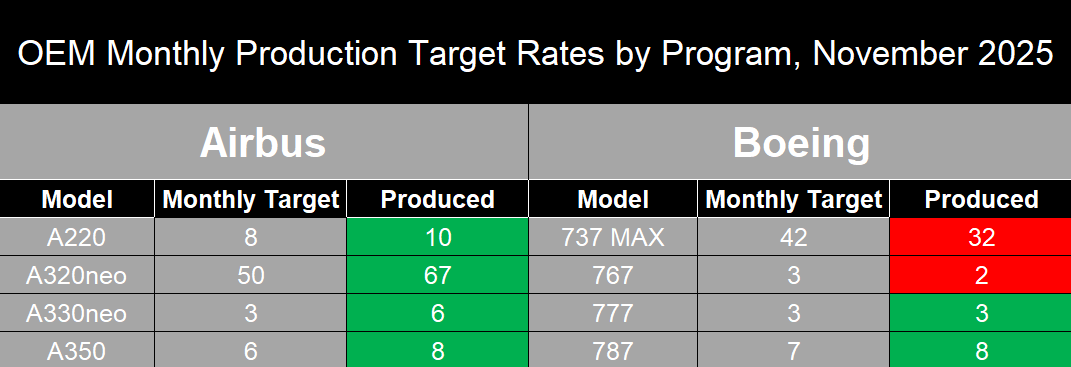
- Monthly production targets are generalized figures based on monthly production estimates derived from OEM guidance and internal research conducted by Forecast International.
Airbus posted a very strong month in November across all major programs, exceeding target rates with 10 A220s produced against a target of 8, 67 A320neos against a target of 50, 6 A330neos against a target of 3, and 8 A350s against a target of 6. Despite this solid performance, and the recent strengthening of A320neo-family output in September, October, and now November, Forecast International continues to assess Airbus’ ability to reach its full-year delivery goal of 820 aircraft. Based on our updated estimates, Airbus would have delivered roughly 656 aircraft through November 30, assuming approximately 74 deliveries in November. If our projections are correct, Airbus will need to deliver 164 aircraft in December to meet its full-year target. For context, Airbus delivered 123 aircraft in December 2024, which means the required push this year is significantly more demanding. This does not mean Airbus cannot achieve the 820 target, as year-end surges are not unprecedented, but it highlights the scale of the acceleration required in the final month of 2025. Because current production rates for the A220, A330neo, and A350 families are not expected to accelerate meaningfully, most of the remaining burden falls on the A320neo line. This implies a delivery pace well above typical monthly levels and above the company’s long-term production target of 75 aircraft per month.
As for the A220 program, production has now stabilized at approximately eight aircraft per month, and November output once again exceeded that benchmark with 10 aircraft completed. Although this steady foundation supports potential future rate increases, our longstanding view that the company’s plan to ramp up to 14 aircraft per month by 2026 was unlikely has now been validated. During its third-quarter earnings call, Airbus revised the 2026 target downward to 12 aircraft per month while leaving open the possibility of pursuing 14 per month over a longer horizon. In our view, 12 per month represents a more realistic long-term steady-state rate given the program’s persistent challenges, including weaker order momentum and ongoing PW1500G engine reliability issues that have grounded roughly one quarter of the global fleet.

A350 production improved in November, with Airbus producing eight aircraft, which is above the current target of six per month. Despite this stronger performance, the program’s overall output for 2025 remains well below plan. Through the end of November, Airbus has produced 55 A350s, averaging five aircraft per month, which is still short of the six-per-month baseline rate needed to stabilize the program. This continues to contrast sharply with the company’s ambitious goals announced at the start of the year, which include raising output to ten aircraft per month by 2026 and to twelve per month by 2028. Forecast International maintains the view that meaningful progress toward those long-term goals will require Airbus to first achieve consistent, repeatable production at or above the current six-per-month target. November was a positive step, but sustained, month-over-month stability remains the primary hurdle.
The A330neo also had a strong month in November, with six aircraft produced, all of them A330-900neos. This comfortably exceeds the current target of three per month and reflects one of the program’s best production performances of the year. Airbus recently announced plans to raise A330neo output from three aircraft per month to five per month by 2029, a target that Forecast International views as both realistic and sustainable. The aging A330ceo fleet continues to approach its replacement window, and we expect a meaningful share of operators to transition to the A330neo rather than switch to alternative widebody platforms. This replacement cycle should help drive additional orders and support higher, more stable production volumes for the aircraft in the second half of the decade.

Boeing’s 737 MAX program recorded 32 aircraft produced in November, below the current target of 42 per month. While this represents a decline from October’s stabilized level of 38 aircraft, the FAA has already approved the increase to 42 per month, and Boeing continues to position the program for a gradual return to higher output. Of the 32 aircraft produced, the vast majority were 737 MAX 8 and MAX 8-200 variants, with four MAX 9s completed. Despite the lower November figure, Boeing remains on a stronger long-term trajectory toward its stated goal of 52 aircraft per month. The manufacturer has confirmed that future rate increases will occur in steps of no more than five aircraft at a time and with no fewer than six months between each increment. Based on this structure, Boeing would require at least one year to reach its long-term target once it begins the next rate rise, and Forecast International maintains that supply chain constraints could push the timeline further, likely into 2027 or 2028, consistent with our current forecast.
Among Boeing’s widebody programs, the 787 was again the strongest performer, with eight aircraft produced in November, matching the current production target and supporting management’s confidence in the program’s upward trajectory. Boeing reiterated in its recent earnings communication that seven per month is now the established rate, with a goal of reaching eight per month by year-end and ten per month in 2026. Reaching eight per month appears achievable even if the milestone slips into early 2026. However, sustaining ten per month will be significantly more challenging, and we would need to observe several consecutive months near eight per month before assessing the higher rate as viable.
As for Boeing’s remaining widebody programs, the company produced one 767-300F, one 767-2C, and three 777Fs in November. We do not anticipate any production rate increases for either the 767 or the 777F. Production of the 767-300F remains scheduled to conclude in 2027, and while development of the 777-8F continues, the aircraft is not expected to enter service until later in the decade. Meanwhile, the 777X remains in certification, though Boeing has pushed its entry into service back once again, shifting the target from 2026 to 2027.
Unofficial/Preliminary Deliveries
Forecast International expects Boeing to have delivered an estimated 44 aircraft in November 2025. Narrowbody activity is projected to include 33 deliveries of the 737, with the majority consisting of MAX 8 and MAX 8-200 variants and a smaller number of MAX 9s and one 737-800A. On the widebody side, we expect Boeing to deliver six 787s, primarily 787-9s with a smaller share of 787-10s. We also project two 777F deliveries and three deliveries across the 767 program.
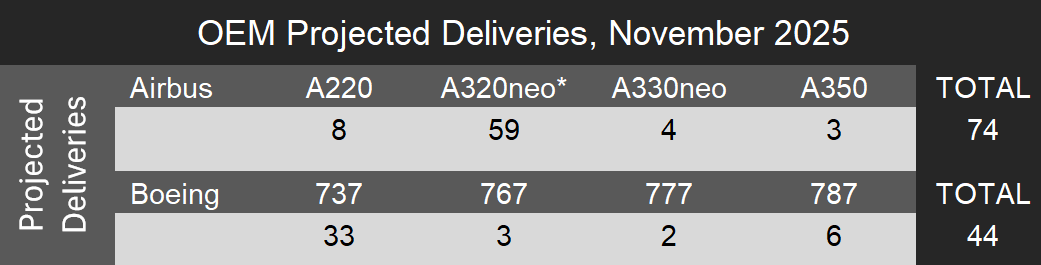
- Delivery data is the expected number that Boeing and Airbus will report in their November 2025 Orders and Deliveries summary and is based on Forecast International’s internal research. Numbers are not official and are not provided by Airbus or Boeing.
- A320neo numbers include all variants for the family; A319neo, A320neo and A321neo
- 737 numbers include 737-800A and 737 MAX variants
As for Airbus, Forecast International projects the manufacturer to have delivered 74 aircraft in November 2025. We expect eight A220s to be delivered during the month. The majority of Airbus’ narrowbody output will again come from the A320neo family, with an estimated 59 deliveries across the A319neo, A320neo, and A321neo. On the widebody side, we project four deliveries of the A330-900neo and three A350 deliveries, reflecting the program’s continued struggle to achieve stability even as monthly production improves.

With diverse experience in the commercial aviation industry, Grant joins Forecast International as the Lead Analyst for Commercial Aerospace. He began his career at the Boeing Company, where he worked as a geospatial analyst, designing and building aeronautical navigation charts for Department of Defense flight operations.
Grant then joined a boutique global aviation consulting firm that focused on the aviation finance and leasing industry. In this role he conducted valuations and market analysis of commercial aircraft and engines for banks, private equity firms, lessors and airlines for the purposes of trading, collateralizing and securitizing commercial aviation assets.
Grant has a deep passion for the aviation industry and is also a pilot. He holds his Commercial Pilots License and Instrument Rating in addition to being a FAA Certified Flight Instructor.