 Source: GE Aerospace
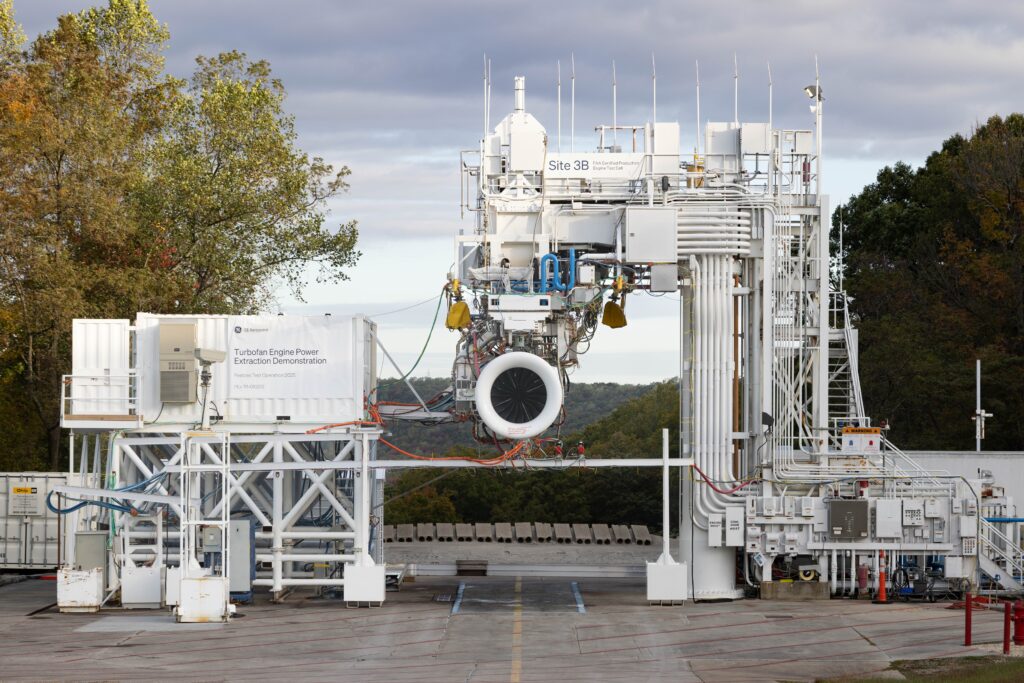
GE Aerospace has successfully demonstrated hybrid-electric capabilities in a commercial turbofan engine. The research could one day lead to a new type of engine capable of powering the next generation of narrow-body airliners.
The ground testing, completed in 2025 at the company’s Peebles Test Operation, utilized a modified Passport engine to validate power transfer, extraction, and injection technologies as part of NASA’s Turbofan Engine Power Extraction Demonstration project.
The newly tested architecture embeds electric motors and generators directly into the gas turbine to supplement power during specific phases of flight. According to the company, the design creates a flexible system capable of operating with or without the use of onboard batteries. GE Aerospace reports that the testing exceeded NASA’s technical performance benchmarks, which were established to identify engine capabilities that provide meaningful fuel cost savings for the U.S. aviation industry.
This demonstration is part of the broader CFM International RISE (Revolutionary Innovation for Sustainable Engines) program. GE Aerospace is a 50/50 partner with French engine-maker Safran in the CFM joint venture.
Since its unveiling in 2021, RISE has completed more than 350 tests and 3,000 endurance cycles to mature technologies like Open Fan architecture and compact cores. The program targets a fuel burn improvement of more than 20% compared to current commercial engines, with plans to advance toward ground and flight tests later this decade.
Expanding the scope of its electrification strategy, GE Aerospace also announced a strategic partnership and equity investment in BETA Technologies in 2025. While the Passport testing focuses on commercial airliners, the collaboration with BETA aims to develop a hybrid-electric turbogenerator for the Advanced Air Mobility (AAM) sector, signaling a wider application of these technologies across the aviation landscape.

Douglas Royce covers the aviation gas turbine and military markets at Forecast International, a market research firm that forecasts annual production across a wide range of aerospace and defense systems.
image sources
- download: GE Aerospace