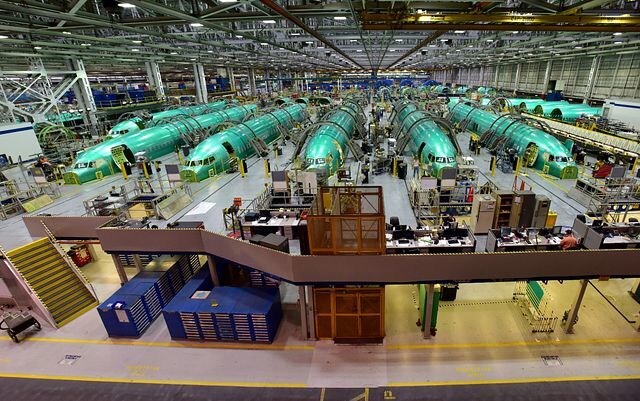
The Boeing Company has officially completed its acquisition of Spirit AeroSystems, marking the end of a two-decade era of outsourcing that began when Boeing spun off its Wichita division in 2005. The transaction, finalized today, effectively re-integrates the manufacturer of the 737 fuselage and other critical aerostructures back into the Boeing parent company.
The move follows safety and quality challenges that have reshaped Boeing’s oversight, including the 737 MAX crashes in 2018–2019 and a 2024 door panel blowout linked to supplier quality issues. Bringing Spirit in-house aims to consolidate manufacturing oversight, improve coordination, and strengthen adherence to safety protocols.
Most importantly, this acquisition represents one of the most significant shifts in Boeing’s manufacturing strategy in recent history, signaling a departure from the fragmented supply chain model and a return to vertical integration.
The Strategic Pivot
For years, the industry trend was to divest component manufacturing to focus on final assembly and systems integration. By buying Spirit back, Boeing is reversing that strategy. The primary driver of this acquisition is control—specifically over quality assurance and supply chain stability.
As an independent supplier, Spirit AeroSystems faced mounting financial pressures that strained its ability to meet Boeing’s production demands. The company carried substantial debt, managed fluctuating revenue streams tied heavily to Boeing programs, and contended with high fixed costs associated with operating multiple global facilities. These financial headwinds, combined with challenges in maintaining consistent quality control, directly affected Boeing’s production lines, contributing to delays and quality lapses in key aircraft programs such as the 737 MAX, 767, 777, and 787.
To stabilize Spirit and ensure continuity of supply, Boeing structured its $8.3 billion all-stock acquisition to absorb Spirit’s outstanding debt—reported at roughly $3.6 billion—and integrate its operations into Boeing’s commercial and aftermarket divisions.
The Airbus Carve-Out: A Parallel Agreement
A critical component of this acquisition was resolving Spirit’s deep ties to Boeing’s chief rival, Airbus. To avoid regulatory antitrust issues and supply chain conflicts, a parallel “carve-out” agreement was necessary.
Initiated in July 2024 and finalized in mid-2025, this complex side deal ensures that operations critical to Airbus programs are transferred directly to the European manufacturer rather than falling under Boeing’s control.
- Global Asset Transfer: Airbus has acquired Spirit assets in Kinston, North Carolina (A350 fuselage sections), St. Nazaire, France (A350 fuselage sections), and Casablanca, Morocco (A220 mid-fuselage).
- The Belfast Split: The most complex aspect of the deal involved the historic Belfast facility in Northern Ireland. While Airbus initially agreed to acquire the A220 wing production lines, the fate of the A220 mid-fuselage and Bombardier-related operations remained uncertain.
- In July 2025, after Spirit confirmed it could not find a third-party buyer for the remainder of the site, a final compromise was reached.
- Airbus will take over the A220 wing and mid-fuselage work, preserving continuity for its single-aisle jet program.
- Boeing will acquire the remaining operations at the Belfast site, including the Bombardier fuselage production. These non-Airbus operations will be rebranded and operated as Short Brothers, a Boeing Company.
How the Boeing Integration Will Work
With the Airbus assets separated, Boeing is restructuring the remaining Spirit assets to fit its existing divisions:
Commercial Manufacturing: Spirit’s commercial operations in Wichita (Kansas), Dallas (Texas), and Tulsa (Oklahoma) will be absorbed directly into Boeing Commercial Airplanes. This includes the production of fuselages for the 737, P-8, and KC-46, as well as structures for the 767 and 777 programs.
Aftermarket Services: Spirit’s maintenance, repair, and overhaul (MRO) businesses will align with Boeing Global Services. This expands Boeing’s footprint in the profitable aftermarket sector, bringing a significant supplier of spare parts and lease portfolios in-house.
Spirit Defense: To manage non-Boeing defense contracts and ensure uninterrupted support for U.S. space and defense programs, Boeing has established a new subsidiary called Spirit Defense. This entity will operate as an independent subsidiary under Boeing Defense, Space & Security.
Workforce and Regional Impact
The transaction brings approximately 15,000 former Spirit employees into the Boeing workforce. The integration is particularly significant for Wichita, Kansas, known as the “Air Capital of the World.”
Local leadership, including Kansas Governor Laura Kelly and U.S. Senator Jerry Moran, have framed the acquisition as a stabilization of the region’s aerospace sector. By securing the financial future of the Wichita plant, the deal protects a massive ecosystem of Tier II and Tier III suppliers in the region that rely on the factory’s output.
Improving Safety and Quality
Boeing CEO Kelly Ortberg described the acquisition as a “pivotal moment,” emphasizing that the integration focuses on safety and quality. The immediate goal is to stabilize the production system, allowing Boeing to ramp up delivery rates to meet airline demand while ensuring that the manufacturing defects that plagued the supply chain in recent years are addressed at the source.

A military history enthusiast, Richard began his career at Forecast International as editor of the World Weapons Weekly newsletter. As the Internet became central to defense research, he helped design the company’s Forecast Intelligence Center and now coordinates the FI Market Recap newsletters for clients. He also manages two blogs: Defense & Security Monitor, which covers defense systems and international security issues, and Flight Plan, focused on commercial aviation and space systems.
For more than 30 years, Richard has authored Defense & Aerospace Companies, Volume I (North America) and Volume II (International), providing detailed data on major aerospace and defense contractors. He also edits the International Contractors service, a database tracking all companies involved in programs covered by the FI library. Richard currently serves as Manager of the Information Services Group (ISG), which develops outbound content for both Forecast International and Military Periscope.